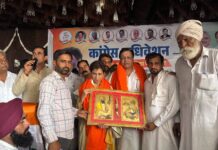
Congress MP Selja urges Centre to review procurement and mandi handling system, calls for insurance, pension and healthcare cover for registered workers
CHANDIGARH | PEN OF DEMOCRACY NEWS DESK
Sirsa MP, former Union Minister, Congress General Secretary and Congress Working Committee (CWC) member Selja raised the issue of livelihood and social security of mandi workers from Haryana, particularly those employed in major grain-producing areas including Sirsa, in Parliament under Rule 377.
Selja urged the Union government to review the existing procurement and mandi handling system and formulate a comprehensive welfare policy to protect the employment and social security of thousands of registered mandi workers.
Raising the matter on the floor of the House, Selja said thousands of workers in Haryana’s mandis have traditionally played an important role in the procurement of foodgrains under the Minimum Support Price (MSP) system. Their work includes cleaning, grading, loading and handling of agricultural produce. She pointed out that these workers also contribute significantly to maintaining the quality of foodgrains eventually supplied to people through the Public Distribution System.
She said that despite their vital role in the agricultural procurement chain, the traditional employment opportunities of mandi workers are gradually being affected by changes in procurement and grain-handling practices. Any restructuring of the system, she stressed, must take into account the livelihood and financial security of workers and their families.
According to Selja, mandi workers have remained an essential link in the agricultural procurement process for decades. From the arrival of farmers’ produce at mandis to cleaning, grading, filling, lifting and storage, workers perform physically demanding tasks under challenging conditions.
She also highlighted concerns over alleged deductions from farmers in the name of cleaning and quality improvement where adequate scientific processing facilities are not available. Such practices, she said, can result in losses for farmers while simultaneously reducing traditional employment opportunities for mandi workers.
Selja called for a transparent and scientific system of grain cleaning and grading based on clearly defined quality standards. She said modernisation of procurement operations was necessary, but technological changes should not result in workers who have supported the system for years being deprived of their livelihoods.
The Congress leader stressed that the government’s responsibility should not end with procurement of foodgrains. Protecting the interests of the farmers and workers who keep the entire procurement and handling system functioning is equally important.
She demanded that registered mandi workers be provided adequate social security, including health and accident insurance, pension and, wherever applicable, Employees’ State Insurance (ESI) benefits. She also called for basic healthcare facilities at major mandis across Haryana so that workers can receive timely medical assistance in case of illness or workplace accidents.
Selja said a comprehensive welfare policy should be formulated for mandi workers, balancing modern technology with employment protection. Such a policy, she said, should ensure that farmers receive a fair price for their produce, workers retain secure livelihoods and consumers receive quality foodgrains.
She emphasised that the issue concerns the livelihood of thousands of families associated with Haryana’s mandis. The Centre, she said, must seriously review the procurement and mandi handling system and ensure that the interests of farmers, workers and consumers are protected together.
POD/DESK