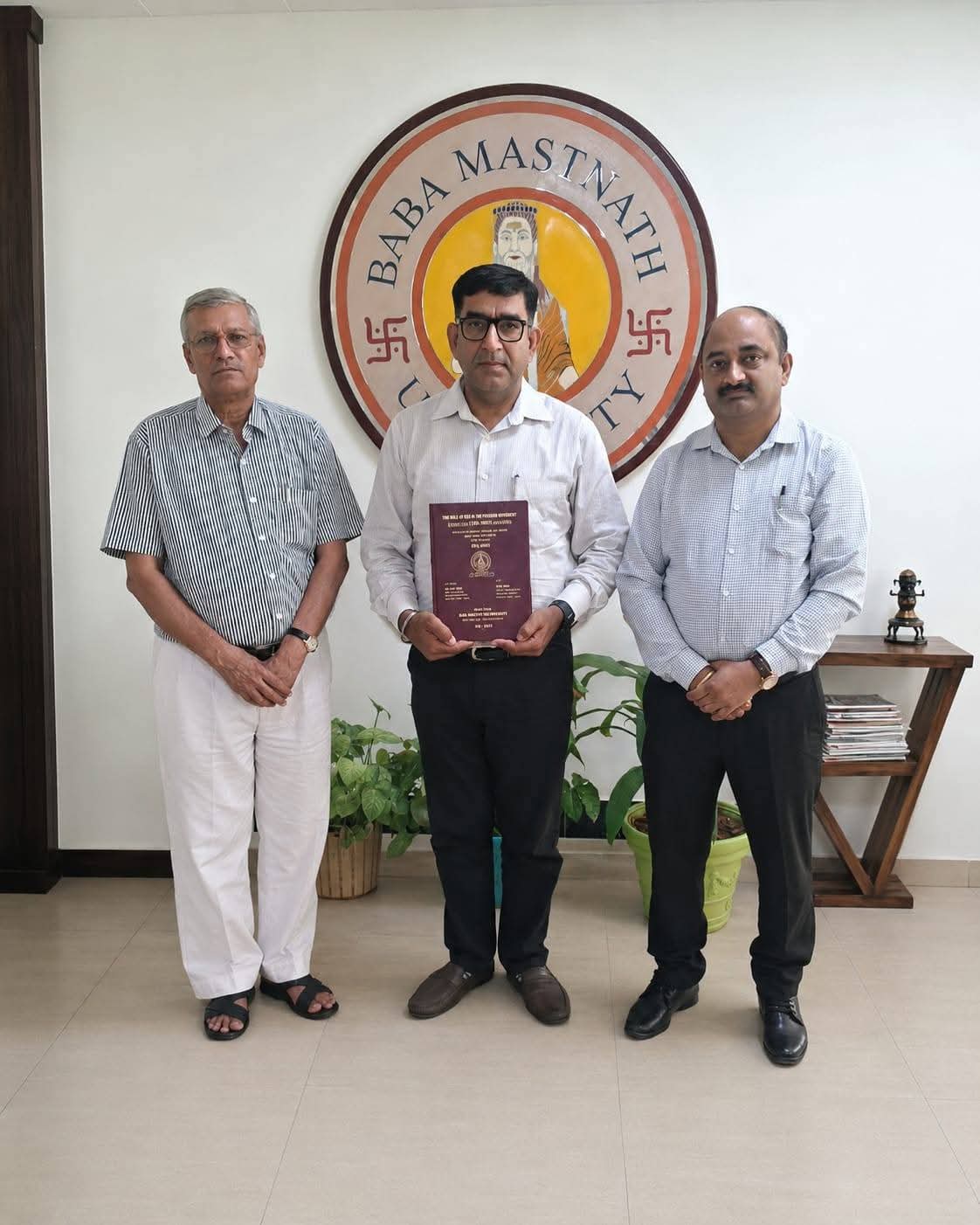
Bhupesh after being awarded his PhD for research on the RSS and India's freedom movement at Baba Mast Nath University.
Jagadhri-based scholar Bhupesh completes analytical study on RSS from 1925–1961, examining historical records, Partition-era relief work and post-Independence nation-building initiatives.
Yamunanagar/Pen of Democracy News Desk
Bhupesh, a resident of Jagadhri and Intellectual Training Head of the Rashtriya Swayamsevak Sangh (RSS) in Haryana, has been awarded a Doctor of Philosophy (PhD) by Baba Mast Nath University, Rohtak, for his research titled “Contribution of the Rashtriya Swayamsevak Sangh in the Indian Freedom Movement (1925–1961): An Analytical Study.” The research was completed under the supervision of Professor Rachna Grover.
According to the researcher, the study examines the role of the RSS during the freedom movement and the early years of independent India through an academic analysis of historical records, archival documents and other available sources covering the period from 1925 to 1961.
As part of the research, Bhupesh also interacted with Hindu families displaced from present-day Pakistan during the Partition of India. The study documents their experiences of migration and rehabilitation while examining accounts related to relief and assistance activities carried out during that period. The research also received academic support from Dr Ramesh Dhariwal, Associate Professor at Government College Aharwala, Bilaspur, and Ajey Kumar, Joint Archives Head of the RSS in Delhi, among other scholars.
The thesis states that the RSS identified two broad objectives during its formative years: strengthening national consciousness and social organisation during the freedom movement, and, in the post-Independence period, contributing to nation-building through character development, social harmony, cultural revival and public service.
The study argues that India’s freedom was not only a political transition but also a wider process involving cultural awareness, national identity and social reconstruction. It attempts to assess the organisation’s activities within that historical context using available documentary evidence.
The research also discusses the role of RSS founder Dr Keshav Baliram Hedgewar, including references to his participation in the freedom movement and imprisonment, while examining historical accounts related to social initiatives, the integration of princely states, rehabilitation of Partition-affected families and campaigns concerning Goa, Daman and Diu.
Speaking after receiving the degree, Bhupesh said the objective of his research was not to promote any particular ideology but to present an academic study based on historical records, archival material and documented sources. He expressed hope that the thesis would serve as a useful reference for researchers, historians and readers interested in studying the role of the RSS during the freedom movement and the nation-building process after Independence.









 in Haryana, has been awarded a Doctor of Philosophy (PhD) by Baba Mast Nath University, Rohtak, for his)