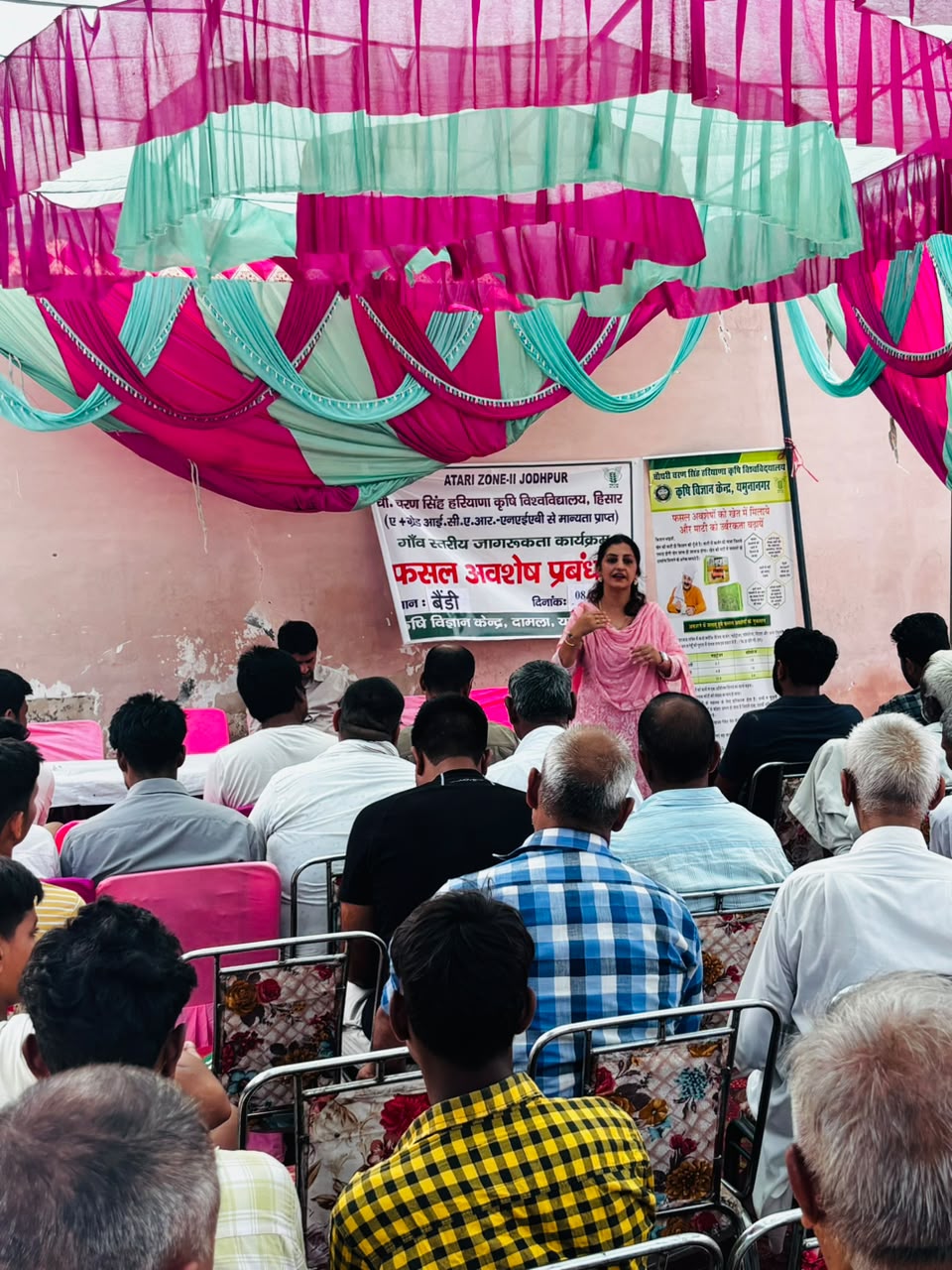
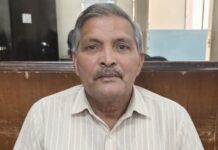
Farmers participate in a crop residue management awareness programme organised by KVK Damla in Bandi village.
KVK Damla organises village-level awareness programme in Bandi, highlighting soil health, nutrient recycling and sustainable farming
YAMUNANAGAR | PEN OF DEMOCRACY NEWS DESK
A village-level awareness programme on crop residue management was organised by the Krishi Vigyan Kendra (KVK), Damla, affiliated with Chaudhary Charan Singh Haryana Agricultural University, Hisar, in Bandi village. Around 60 progressive farmers participated in the programme and received detailed information on scientific and practical techniques for managing crop residues without resorting to burning.
Addressing the farmers, KVK Damla coordinator Dr Sandeep Rawal said crop residues should not be viewed merely as agricultural waste left behind in fields. He explained that such residues contain valuable organic matter and nutrients which, when managed scientifically, can be incorporated back into the soil and contribute to maintaining soil fertility and improving overall soil health.
Dr Rawal emphasised the importance of carbon in agricultural ecosystems and said crop residues play a significant role in maintaining soil quality. Incorporating suitable residues into the soil can help increase organic matter, improve soil structure and facilitate the recycling of nutrients. Such practices can also contribute to maintaining the productive capacity of agricultural land over the long term.
Agronomy expert Dr Aradhana Bali provided farmers with detailed information about various crop residue management techniques. She explained that there is no single method suitable for every field and that farmers should select an appropriate technique after considering the quantity of crop residue available, the crop to be planted next, the time available between two crops and the specific conditions of the field.
She discussed several methods of managing residues, including incorporating crop residues into the soil and using them as mulch. Farmers were also informed about techniques that can increase the usefulness of crop residues and the agricultural machinery suitable for implementing different residue management practices.
Dr Bali urged farmers to avoid burning crop residues and instead adopt management practices suited to their individual field conditions. She said scientific residue management could help conserve organic matter in the soil, recycle nutrients and improve the physical quality of agricultural land.
She further explained that appropriate management of crop residues could contribute to the long-term sustainability of farming systems. Instead of treating residues as a burden requiring disposal, farmers can use them as a valuable resource within the farm ecosystem.
The experts also highlighted the importance of selecting machinery and techniques according to local conditions. The availability of suitable equipment, the amount of residue and the time gap between harvesting one crop and sowing the next can all influence the success of residue management practices.
During the programme, farmers actively interacted with the agricultural scientists and raised several technical and practical questions related to crop residue management. The experts responded to their queries and provided guidance based on local farming conditions.
The interaction also enabled farmers to understand the practical aspects of implementing residue management techniques in their own fields. Agricultural scientists encouraged them to adopt scientifically recommended practices rather than relying on residue burning as a quick method of clearing fields.
The programme focused particularly on creating awareness about the environmental and agricultural consequences of residue burning while promoting practical alternatives. The experts stressed that crop residues can become an important resource when handled properly, helping farmers improve soil quality instead of losing valuable organic matter through burning.
The organisers said the programme was aimed at encouraging farmers to change their perception of crop residues and recognise them as an agricultural resource rather than waste. Scientific management can allow nutrients and organic material contained in residues to remain within the farming system and support soil productivity.
The initiative also sought to strengthen farmers’ participation in finding practical and sustainable solutions to the problem of crop residue burning. Direct interaction between farmers and agricultural scientists provided an opportunity to discuss field-level challenges and identify techniques that can be adapted to local conditions.
Experts said maintaining soil health is essential for sustainable agricultural production. Regular incorporation of organic material, appropriate residue management and nutrient recycling can contribute to healthier soils and more sustainable production systems.
Farmers were encouraged to make informed decisions based on their cropping pattern, available machinery, field conditions and the time available before the next crop. Such a context-specific approach can improve the effectiveness of residue management and reduce dependence on burning.
The programme concluded with an emphasis on greater awareness, scientific guidance and farmer participation. The agricultural experts encouraged farmers to adopt suitable residue management practices and contribute to reducing crop residue burning while protecting soil resources.
The organisers said awareness programmes of this nature can play an important role in bridging the gap between agricultural research and field-level practices. By providing farmers with technical knowledge and practical solutions, such initiatives can encourage wider adoption of sustainable crop residue management.
The message emerging from the programme was clear: crop residues need not be treated as an unwanted by-product. With appropriate scientific practices, they can become a useful component of the farming system, helping conserve organic matter, recycle nutrients, improve soil quality and support the long-term sustainability of agriculture.