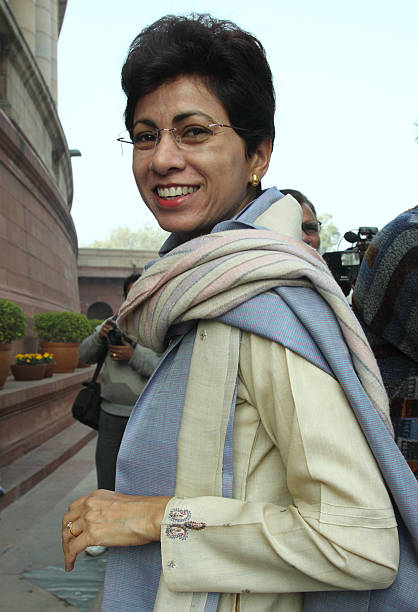
Kumari Selja, Sirsa MP and Congress national general secretary.
Sirsa MP Selja says rising sugar prices are increasing the burden on households, while warning that no eligible voter should be denied the right to vote in the name of electoral roll revision
CHANDIGARH | PEN OF DEMOCRACY NEWS DESK
Sirsa Member of Parliament, former Union Minister, Congress national general secretary and CWC member Kumari Selja has criticised the BJP-led Central government over concerns related to rising sugar prices and declining domestic stocks, alleging that inadequate policy planning has added to the financial burden on ordinary consumers. In a separate statement, she also expressed concern over alleged irregularities in the revision of electoral rolls in Uttarakhand, saying that no eligible voter should be deprived of the right to vote in the name of administrative verification or revision.
Addressing the issue of rising sugar prices, Selja said that the government should have taken timely and effective steps when indications of pressure on domestic sugar availability first began to emerge. According to her, instead of preparing a long-term policy to protect domestic supplies and future consumer requirements, sugar exports were permitted and a significant portion of sugarcane production was increasingly diverted towards ethanol manufacturing.
She said that the consequences of these decisions were now being felt by ordinary households, particularly poor and middle-class families already struggling with the rising cost of essential commodities.
Selja said that sugar prices had reportedly increased significantly during the past three months, adding further pressure to household budgets. She also pointed to increases in the prices of other essential commodities, including jaggery, rice and maize flour, and said that inflation was making it increasingly difficult for families to manage their regular kitchen expenses.
“Sugar is a daily household requirement and a sharp increase in its price cannot simply be dismissed as an ordinary market fluctuation,” she said.
The Congress leader further raised concerns regarding reports suggesting that the opening stock of sugar mills could remain considerably lower compared with the previous year. She said that if the country is eventually compelled to depend on imported raw sugar to meet domestic requirements, serious questions would arise regarding policy planning, supply management and the government’s ability to maintain an adequate balance between production, consumption and exports.
Selja said that reports indicating the possible need to consider importing around 10 lakh tonnes of raw sugar duty-free reflected the seriousness of the supply situation. She argued that a country with substantial sugarcane production should have a well-planned system capable of ensuring sufficient domestic availability before making decisions that could affect supplies.
She also questioned whether the growing emphasis on ethanol production had been accompanied by adequate safeguards to ensure that domestic sugar availability was not adversely affected.
The Centre, she said, had promoted ethanol blending as part of a broader effort to reduce dependence on imported petroleum products and save foreign exchange. However, she argued that the government also had a responsibility to ensure that the increased use of sugarcane for ethanol production did not create a shortage of sugar or contribute to higher prices for consumers.
“Achieving one policy objective should not result in making another essential household commodity unaffordable for ordinary people,” Selja said.
She further stated that the government must address concerns relating to the growing use of ethanol in fuel, including questions raised by consumers about the compatibility and mileage of older vehicles. According to Selja, people deserve clear and factual information on issues that directly affect their vehicles and household expenses.
She alleged that the impact of what she described as flawed economic policies was repeatedly being borne by ordinary citizens and the middle class.
Calling for greater transparency, Selja demanded that the Central government publicly provide clear information regarding the country’s actual sugar production, available stocks, domestic consumption, exports and the quantity of sugarcane being diverted towards ethanol production.
She said that India needs a long-term and balanced policy that protects the interests of farmers while also ensuring stable supplies and reasonable prices for consumers. Such a policy, she added, should ensure that sugarcane growers receive remunerative prices, ethanol production continues in a balanced manner and households are not forced to pay excessively high prices for an essential commodity.
Concerns Raised Over SIR and Alleged Removal of Eligible Voters
In another political statement, Kumari Selja raised concerns over alleged irregularities connected with the Special Intensive Revision, or SIR, of electoral rolls in Uttarakhand.
She said that while maintaining accurate and updated electoral rolls is essential for a healthy democracy, the revision process must not result in any eligible citizen being unfairly deprived of the right to vote.
Selja expressed disappointment over reports concerning Congress leaders allegedly being stopped while attempting to submit a memorandum to the Election Commission regarding concerns over the electoral revision process.
She said that constitutional institutions must function independently, transparently and impartially, particularly when dealing with issues directly connected to citizens’ democratic rights.
“Removing the name of an eligible voter without following proper procedure is a direct attack on that person’s democratic rights,” she said.
According to Selja, electoral roll verification should be conducted carefully and fairly, with adequate safeguards available for citizens whose names may have been removed or marked for deletion. She said that maintaining the accuracy of voter lists is important, but administrative procedures should not become a reason for denying eligible citizens their constitutional right to participate in elections.
The Congress leader called for the SIR process in Uttarakhand to be conducted in a transparent manner. She demanded an impartial review of names that have allegedly been removed from electoral rolls and said that eligible voters should have their names restored wherever necessary.
She also called for accountability if any deliberate irregularities or wrongful actions are found during the revision process.
Selja said that the right to vote forms one of the strongest foundations of India’s democratic system and that every eligible citizen must be given a fair opportunity to ensure that his or her name is correctly included in the electoral roll.
She stressed that the responsibility of electoral authorities is not only to maintain accurate records but also to ensure that citizens are not excluded because of procedural lapses, administrative errors or alleged irregularities.
The two issues raised by Selja — the rising cost of essential commodities and concerns surrounding voter rights — reflect broader questions about economic management and democratic participation, she said. While consumers require stable prices and reliable availability of daily necessities, citizens also need confidence that their right to vote will remain protected through transparent and impartial electoral processes.
Selja urged the Central government to adopt a clearer and more balanced approach towards sugar production, ethanol policy and supply management, while also ensuring that electoral authorities maintain the highest standards of fairness and transparency during voter list revision exercises.
She said that both economic security and democratic rights directly affect ordinary citizens and therefore require responsible policymaking, transparency and timely corrective action.