Experts encourage students to transform innovative ideas into viable ventures through skill development, prototype validation and effective value creation
YAMUNANAGAR | PEN OF DEMOCRACY NEWS DESK
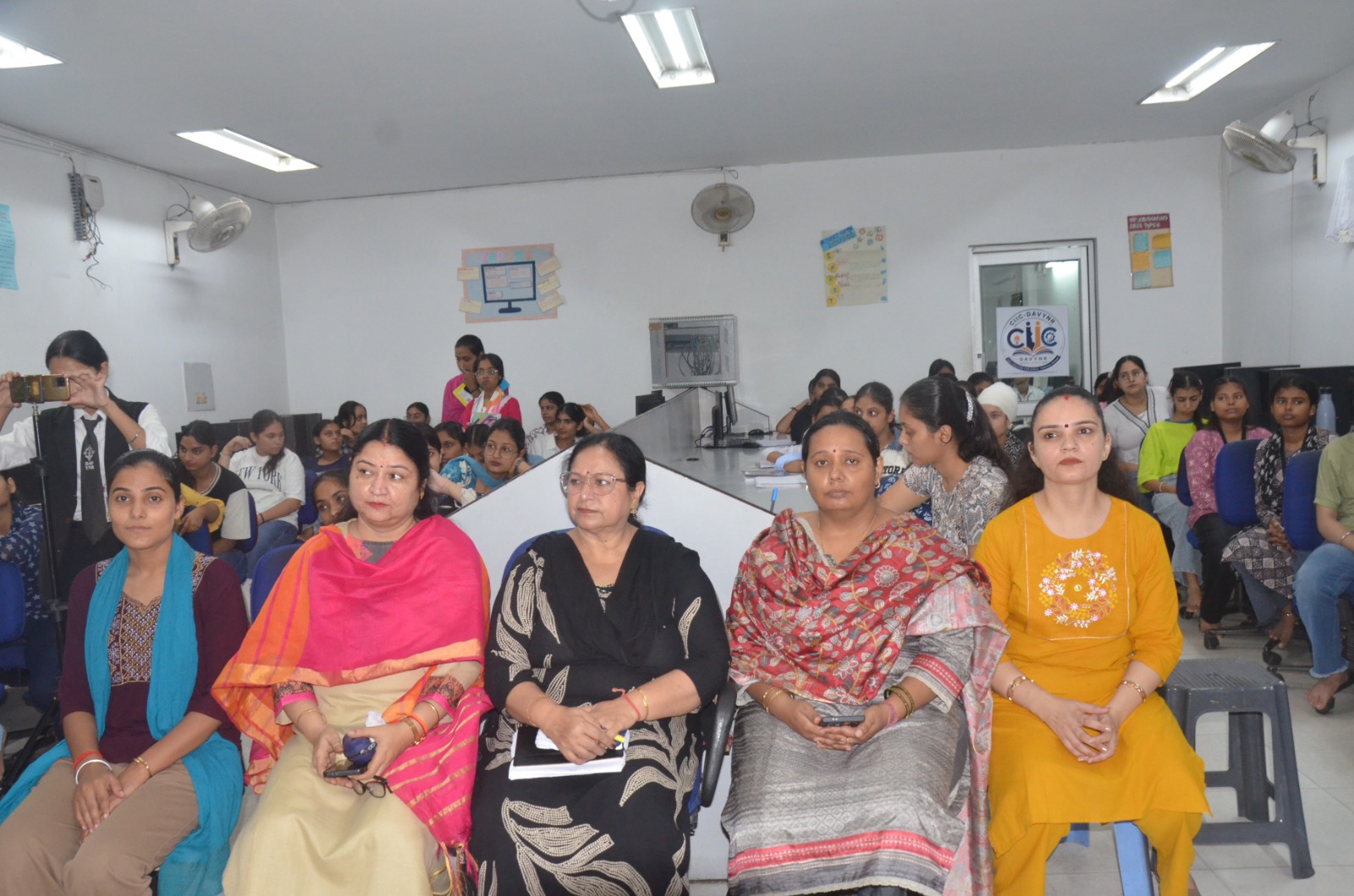
DAV Girls College organised a series of extension lectures on “Startup Ecosystem Enablers” and “Prototype Validation, Value Proposition Fit and Business Viability” under the aegis of its Institution’s Innovation Council (IIC), with the objective of encouraging students to explore entrepreneurship, innovation and self-employment opportunities. The programme focused on helping young students understand how innovative ideas can be developed, tested and eventually transformed into sustainable business ventures.
The extension lectures brought together experts from the fields of entrepreneurship, innovation and skill development, who interacted with the students and shared practical insights into the process of starting and developing a business. Ravi Prakash Goyla, Director of PNB Rural Self Employment Training Institute, and Innovation Ambassador Parul Singh were the main speakers at the programme.
The event was organised under the guidance of DAV Girls College’s officiating principal Dr Surinder Kaur, IIC Vice-President Dr Sunita Kaushik and Convener Vivek. The speakers emphasised that entrepreneurship is becoming an increasingly important career option for young people and that students should develop the confidence to convert their creative and useful ideas into practical solutions and business opportunities.
Addressing the students, Ravi Prakash Goyla encouraged them to think beyond conventional career options and explore the possibilities available in the startup and self-employment sector. He said that many successful businesses begin with a simple idea aimed at solving a problem or fulfilling a particular need. With proper planning, training, guidance and determination, such ideas can be developed into successful ventures.
He informed the students that several government initiatives and schemes are available to promote startups and self-employment. Young people who wish to convert their ideas into businesses can also access training and guidance to better understand the process involved in establishing and managing an enterprise.
Goyla explained various stages involved in starting a venture and highlighted the importance of identifying a viable idea, understanding the market, assessing customer needs and preparing a practical business plan. He also discussed the importance of acquiring relevant skills and knowledge before entering the entrepreneurial sector.
The session focused on the idea that innovation should not remain limited to theoretical discussions. Students were encouraged to examine whether their ideas could solve real-world problems and whether there was a genuine demand for the proposed product or service. The concept of prototype validation was also discussed as an important stage in the process of developing an idea into a commercially viable product.
The speakers explained that before investing significant resources in a business idea, entrepreneurs need to test their concepts and understand whether the proposed product or service meets the expectations and requirements of potential customers. A strong value proposition, they said, plays an important role in helping a new venture establish its identity in a competitive market.
Dr Natasha highlighted the importance of practical skills along with academic qualifications. She said that while degrees provide students with academic knowledge, practical skills help them apply that knowledge effectively in professional and entrepreneurial environments.
She informed the students that the college is conducting various skill-based courses aimed at strengthening their practical abilities and preparing them for a changing employment landscape. Developing professional, technical and entrepreneurial skills, she said, can help students become more confident and capable of exploring diverse career opportunities.
Convener Vivek used the example of Shark Tank to explain how even a small idea can grow into a major business when supported by the right direction, planning, innovation and consistent effort. He encouraged students to believe in their ideas and work systematically towards improving them.
The discussion also highlighted the importance of presenting an idea effectively before potential investors, customers and other stakeholders. A successful entrepreneur, the speakers noted, must not only have an innovative idea but should also be able to explain its usefulness, identify the target market and demonstrate its commercial potential.
Innovation Ambassador Parul Singh spoke about entrepreneurial opportunities in sectors such as the textile industry and home-made food products. She explained that many products prepared on a small scale can find a larger market if attention is given to quality, packaging, branding and marketing.
She said that home-based food products and traditional recipes can also be developed into business opportunities when entrepreneurs maintain quality standards and understand consumer preferences. Similarly, the textile sector offers several possibilities for innovation, product development and small-scale entrepreneurship.
Parul Singh encouraged students to explore opportunities available around them and identify products or services that could be improved or presented in a more innovative manner. She said that entrepreneurship does not always require beginning with a large investment, as many successful ventures start on a small scale and grow gradually through consistent effort and effective planning.
During the programme, students also watched online lectures by Parmit Das, Programme Director of Atal Innovation Mission, and Deepali Upadhyay, Programme Lead. Their expert sessions added a broader perspective to the discussions on innovation, entrepreneurship and the development of startup ecosystems.
The online interaction provided students with an opportunity to understand the wider framework supporting innovation and entrepreneurship in the country. The speakers highlighted the importance of nurturing innovative thinking among young people and creating an environment where students feel encouraged to experiment with new ideas.
The programme underlined the role of educational institutions in promoting entrepreneurship alongside traditional academic learning. With changing economic and employment trends, colleges are increasingly focusing on skill development, innovation and practical exposure to prepare students for emerging opportunities.
The organisers said that such extension lectures help students understand the journey from an idea to a business venture. Concepts such as prototype development, market validation, value proposition and business viability can help young innovators make informed decisions before launching their products or services.
The programme concluded with an encouragement to students to develop a mindset of innovation, continuous learning and self-reliance. They were advised to identify their strengths, acquire practical skills and make effective use of the training and entrepreneurial opportunities available to them.
Dr Parmesh Kumar and Dr Shikha contributed to the successful organisation of the programme.
POD/DESK