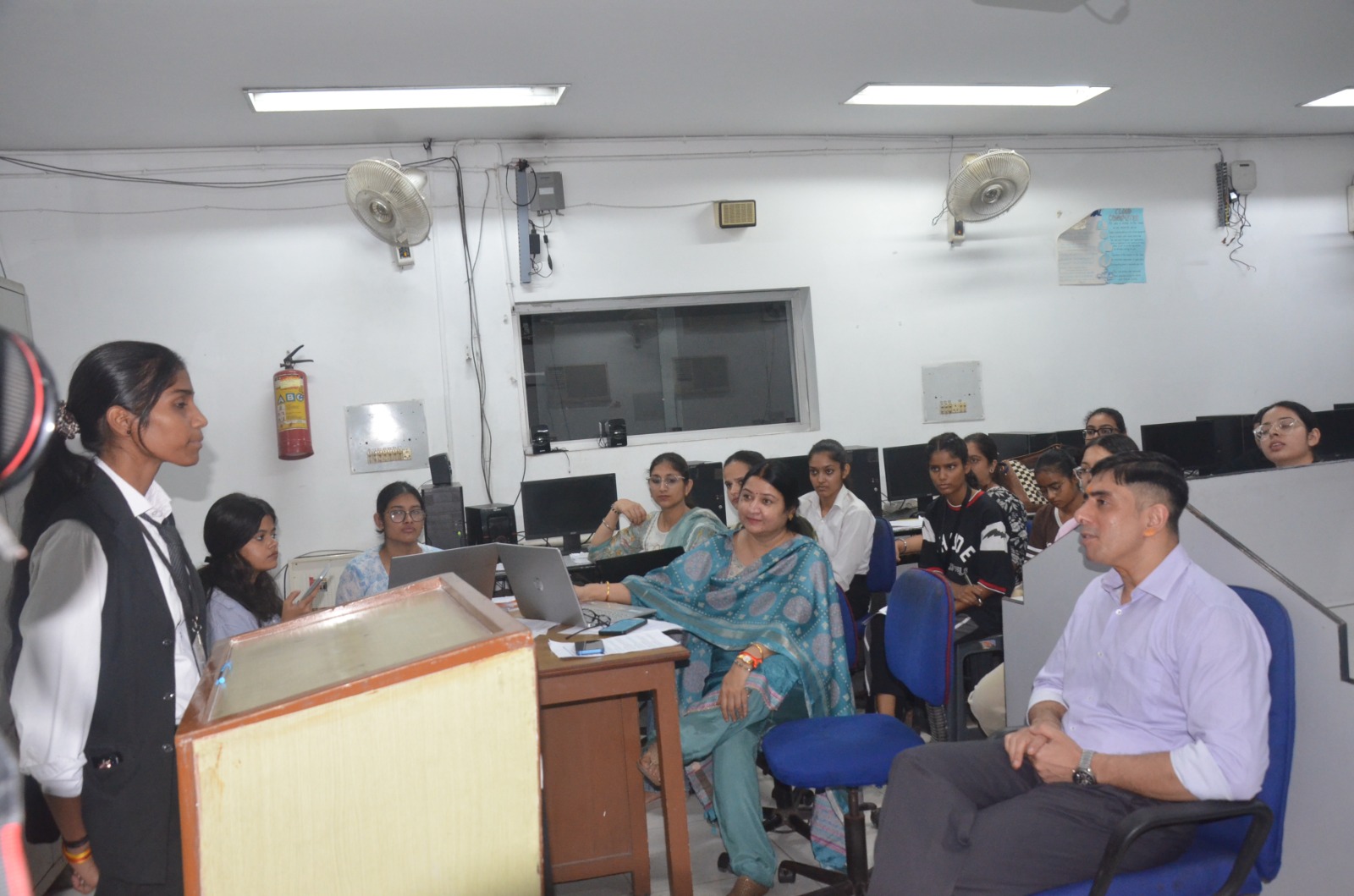
Students present their innovation-based ideas during the Demo Day and Start-up Presentation programme at DAV College for Girls, Yamunanagar
Students present innovation-driven solutions to social and practical challenges; experts provide guidance on prototypes, testing and start-up development
PEN OF DEMOCRACY NEWS DESK YAMUNANAGAR
DAV College for Girls, Yamunanagar, organised a Demo Day and Start-up Presentation programme to encourage innovation, creativity and entrepreneurial thinking among students. The event was organised by the Institution’s Innovation Council (IIC) in collaboration with the Campus Innovation and Incubation Centre, providing students with an opportunity to present their innovation-based ideas aimed at addressing social and practical challenges.
The programme was chaired by IIC Vice-President Dr Sunita Kaushik and Convener Vivek. During the event, students presented a range of ideas and explained the objectives, usefulness and potential commercial applications of their proposed initiatives.
The programme was designed to provide students with a platform where ideas emerging from their academic experiences and observations of everyday problems could be discussed, evaluated and developed further. The organisers said such activities are important for creating an innovation-oriented environment on campus and encouraging students to look at common problems from a solution-oriented perspective.
Among the students who presented their ideas was Gurpreet Kaur, a first-year BCom student, who focused on the reuse of old clothes. Her concept highlighted the possibility of giving discarded or unused clothing a new purpose rather than allowing it to become waste. The idea also reflected growing awareness around sustainable consumption and the need to explore practical approaches to reducing waste.
Aayushi, a final-year BCom Honours student, presented an idea related to fitness. Through her presentation, she discussed the relevance of maintaining a healthy lifestyle and the possible scope of developing an initiative around fitness and well-being.
Gayatri, a second-year BCom General student, presented an idea centred on scented candles. Her presentation explored the possibility of developing a product-based venture with potential commercial value. Such student-led concepts, the organisers said, can provide an initial foundation for learning about product development, customer preferences, marketing and entrepreneurship.
Mannat Kamboj, a second-year BA Psychology Honours student, presented an idea related to peer empathy. Her concept focused on the importance of understanding and supporting fellow students and highlighted a social dimension to student innovation.
The students explained their respective ideas before the panel and discussed their objectives, practical usefulness and possible business models. The presentations provided an opportunity for them to move beyond theoretical classroom learning and consider how ideas could be transformed into practical initiatives.
Convener Vivek said the college’s incubation centre would provide students with expert guidance, necessary facilities, networking support and assistance in developing prototypes. He said the objective was to help students take their ideas beyond the presentation stage and gradually convert promising concepts into viable start-ups.
He explained that students with innovative ideas often require guidance and resources to understand the process of developing a concept into a workable product or service. An incubation centre can help bridge this gap by providing access to mentorship, technical support, networking opportunities and facilities required for prototype development.
Vivek encouraged students to make full use of the support available through the incubation centre. He said the institution would continue to create opportunities for students to experiment with new ideas and develop an entrepreneurial approach towards problem-solving.
The programme also featured an interaction with Mukul Gujral, founder of Amritansh Solutions, Ambala, who provided students with insights into the functioning of incubation centres and the opportunities available to aspiring entrepreneurs.
Gujral explained how innovation-based ideas can progress through different stages before becoming successful ventures. He encouraged students to work systematically on their concepts, develop prototypes, test them and use feedback to improve their proposed products or services.
He also highlighted the importance of moving from an idea to practical execution. According to the organisers, students need to understand that a promising concept is only the first stage of the entrepreneurial journey. Prototype development, testing, refinement, market understanding and business planning are equally important for converting an idea into a sustainable start-up.
The interaction also gave students an opportunity to understand the practical challenges associated with entrepreneurship. Expert guidance can help young innovators identify gaps in their ideas, evaluate feasibility and understand how their concepts can be developed according to the needs of potential users.
Innovation Ambassador Mamta Thapar and Mukul Gujral evaluated the student presentations. The evaluation provided students with an opportunity to receive expert feedback on the strengths and possible areas of improvement in their respective concepts.
The organisers said evaluation by professionals and innovation experts can help students understand their ideas from a practical perspective. Feedback at an early stage can enable students to refine their concepts before investing significant time and resources in prototype development.
The Demo Day also reinforced the role of educational institutions in promoting entrepreneurship among young people. Colleges can provide an important environment for students to identify problems, experiment with solutions and develop the confidence required to present their ideas before experts.
The organisers said the participation of students from different academic disciplines was particularly valuable because innovation can emerge from diverse fields. Business, fitness, sustainability, product development and psychology-related concepts presented during the event demonstrated the range of ideas being explored by students.
The idea presented by Gurpreet Kaur around the reuse of old clothes reflected an environmental and sustainability-oriented approach, while Gayatri’s scented candle concept represented a product-based entrepreneurial possibility. Aayushi’s fitness idea focused on well-being, and Mannat Kamboj’s peer empathy concept addressed an important social and interpersonal dimension.
The organisers maintained that encouraging students to identify problems around them and develop possible solutions can help build a culture of innovation. Such programmes also provide students with experience in communication, presentation, critical thinking and entrepreneurship.
The event further encouraged students to view challenges as opportunities for innovation. By presenting their ideas before experts, participants were able to receive feedback and gain greater clarity about the next steps required to develop their concepts.
The college said the Campus Innovation and Incubation Centre would continue supporting promising student ideas through appropriate guidance and facilities. The objective is to create a structured environment in which students can develop prototypes, test their concepts and explore the possibility of building sustainable ventures.
The programme was successfully organised with the contribution of Dr Parmesh Kumar, Jasmeet Kaur, Shaily Chauhan and Vaishali. Their efforts helped facilitate the presentations and ensure the smooth conduct of the event.
The Demo Day concluded with students gaining practical exposure to the early stages of innovation and entrepreneurship. The organisers expressed the hope that the ideas presented during the programme would encourage students to continue working on their concepts and take them towards prototype development and potential start-up formation.
The initiative marked another step towards strengthening innovation and entrepreneurial culture among students at DAV College for Girls. By combining institutional support with expert mentoring and student creativity, the programme provided a platform for young innovators to transform their ideas into practical solutions with potential social and commercial value.