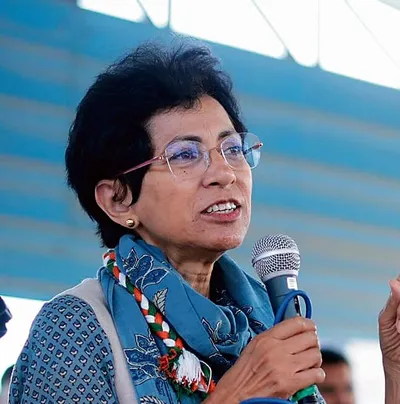
Congress national general secretary and Sirsa MP Kumari Selja speaks on unemployment, inflation, public services and law and order.
Congress leader Selja raises concerns over teacher vacancies, shortage of doctors and deteriorating civic services; demands time-bound recruitment and improvement in basic facilities
CHANDIGARH | PEN OF DEMOCRACY NEWS DESK
Sirsa MP, former Union Minister, Congress General Secretary and CWC member Kumari Selja has alleged that the BJP government in Haryana is continuously weakening the state’s public institutions instead of strengthening them. She said a large number of teaching posts remain vacant in government schools, government hospitals are facing shortages of doctors and other staff, while residents in several cities continue to face problems related to sanitation, sewerage and drinking water.
In a statement issued to the media, Kumari Selja said the condition of government schools raises serious questions about the priorities of the state government. According to figures cited by her, out of 1,16,331 sanctioned posts of teachers and principals/headmasters in Haryana’s government schools, only 91,554 posts are currently occupied. She said this leaves 24,777 regular vacancies, of which arrangements have been made for 6,237 posts through the Haryana Kaushal Rozgar Nigam (HKRN). Despite this arrangement, she said, a gap of 18,540 posts remains.
Selja said the shortage of teachers has a direct bearing on the quality of education being provided to children in government schools. She questioned how the government could ensure quality education when a substantial number of sanctioned teaching positions remain vacant for prolonged periods.
She said the situation was particularly concerning in the TGT/ESHMs category, where a net shortage of 8,126 posts has reportedly been identified. Similarly, she said there is a gap of 6,016 posts at the PGT level, while 3,051 JBT/PRT posts are reportedly vacant. At the level of principals and headmasters, she said, 1,347 posts are also vacant.
Kumari Selja said the government must explain how rationalisation of posts can address the fundamental problem of inadequate manpower if significant vacancies continue to exist even after the process. She stressed that government schools serve a large section of children, particularly from economically weaker and middle-class families, and therefore their staffing and infrastructure cannot be compromised.
She said the problem was not confined to the Education Department. According to her, complaints regarding shortages of doctors, specialist physicians, nursing personnel and supporting staff in government hospitals and healthcare institutions have also been emerging from different parts of Haryana.
She said patients are often required to wait for examinations and treatment because of staff shortages and, in some cases, are compelled to approach private hospitals. This places an additional financial burden on families, particularly those who depend on affordable public healthcare.
“Education and health are basic responsibilities of any government,” Selja said, adding that the government cannot withdraw from these essential public services or allow them to weaken because of prolonged vacancies.
The Congress leader also raised concerns over civic amenities in Haryana’s urban areas. She said residents in several cities are repeatedly complaining about poor sanitation, blocked sewer lines and inadequate or contaminated drinking water. In some places, she alleged, piles of garbage, overflowing sewerage and insufficient water supply have become persistent problems.
Selja said the government should address the legitimate concerns of sanitation and other municipal employees through dialogue and ensure that urban local bodies function effectively. Keeping essential civic services disrupted for long periods, she said, is neither in the interest of employees nor the general public.
She also criticised the growing dependence on HKRN, outsourcing and contractual arrangements, arguing that such mechanisms cannot become a permanent substitute for regular government recruitment.
According to Selja, where the nature of work is permanent, sanctioned posts should be filled through transparent recruitment in accordance with established rules. She said providing adequate manpower and necessary resources to government institutions is the responsibility of the government.
She cautioned that leaving sanctioned posts vacant for years gradually weakens public institutions. As government services become understaffed, citizens increasingly turn to private providers, which can further increase the financial burden on ordinary families.
Selja said the Congress has a clear policy of strengthening public education, healthcare and civic services and making them accessible, accountable and responsive to citizens. She said the government should not weaken the public system in the name of expanding the role of the private sector.
She stressed that strong government schools, hospitals and municipal services are particularly important for poor and middle-class families because they provide essential social protection and affordable access to basic services.
The Congress leader demanded that the Haryana government announce a time-bound recruitment programme to fill vacancies in the Education and Health Departments and other essential services. She also called for immediate corrective measures to improve sanitation, sewerage and drinking water facilities in urban areas.
She further urged the government to reconsider the policy of keeping permanent sanctioned posts vacant for extended periods while relying on HKRN and temporary arrangements.
Selja said the real measure of development should not be limited to government announcements, major projects or infrastructure claims. According to her, development must ultimately be reflected in the quality of basic services available to ordinary citizens.
She said a genuinely developed Haryana should ensure that children receive quality education in adequately staffed government schools, patients receive timely treatment in properly equipped public hospitals and residents have access to clean surroundings, functional sewerage systems and safe drinking water.
She called upon the state government to focus on strengthening existing public institutions and ensuring that government services reach citizens efficiently rather than allowing shortages of manpower and resources to undermine the system.