Dr Krishna Kumar
Scholar of Caste Politics in Haryana | Author of the Springer-published book “Understanding Caste in India: Prejudice, Discrimination and Exclusion”
A prolonged agitation over regularisation, wages, job security and dignity is exposing the deeper intersection of caste, labour and contractual employment
EDITORIAL«««PEN OF DEMOCRACY NEWS DESK
The prolonged strike by sanitation workers in Haryana, which began on August 6, 2026, has evolved into a significant labour confrontation, extending far beyond the immediate disruption of sanitation services. With garbage accumulating in several towns and cities, the agitation has once again brought public attention to the importance of sanitation workers and the consequences of prolonged disruption to essential civic services.
Yet, the central issue is not merely the removal of garbage. The movement has raised deeper questions about contractual employment, regularisation, wages, social security, occupational safety and dignity of labour. More importantly, it has brought into focus the intersection of caste and class in a profession that has historically been associated with particular communities.
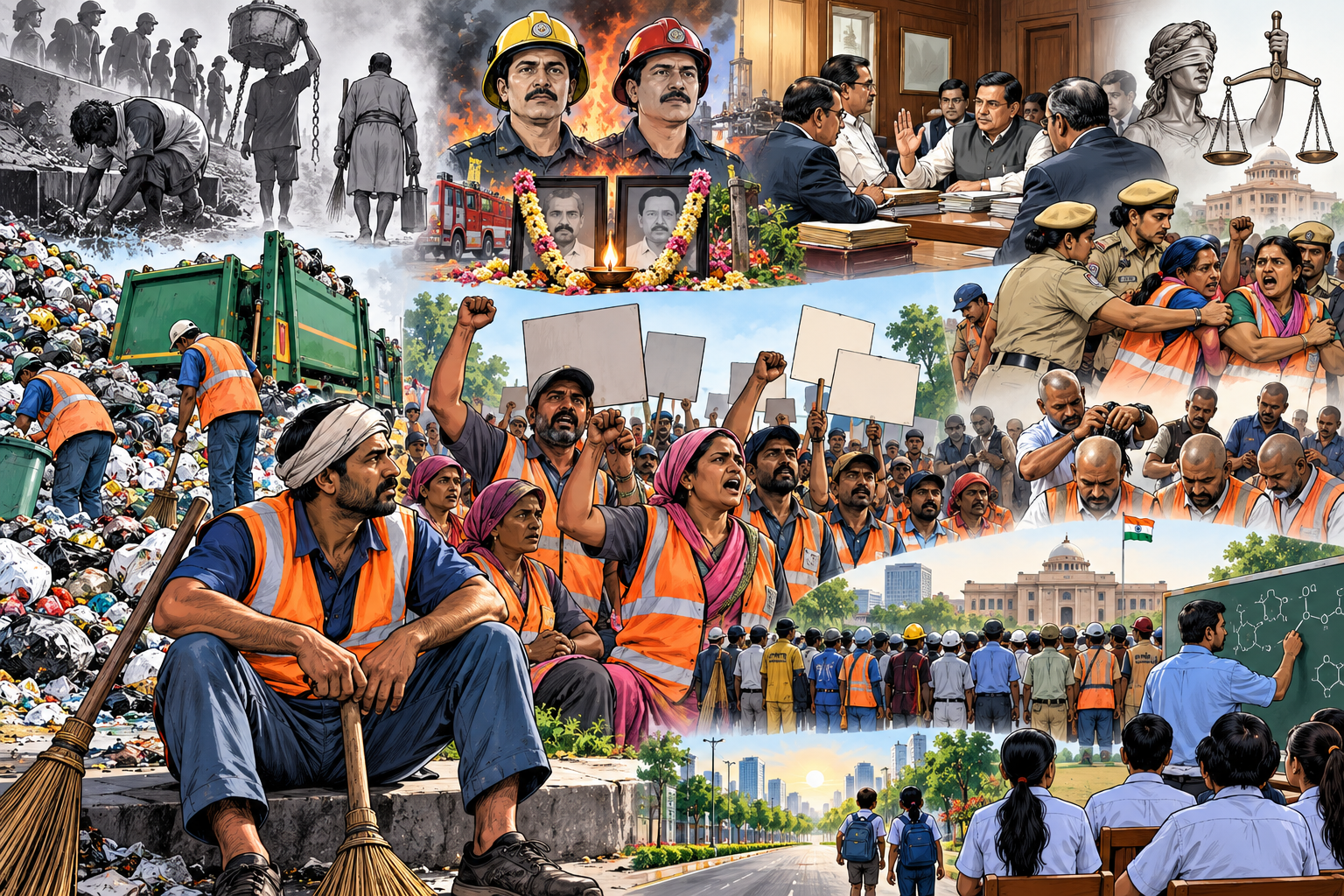
The present agitation can be traced back to April 8, when the Haryana Fire Department Employees Union launched a statewide strike. The union demanded “martyr” status for firemen Bhawichand Sharma and Ranveer Singh, who died in a chemical explosion in Faridabad, along with compensation of ₹50 lakh for their families and government employment for their dependants. It also sought regularisation of payroll firemen and drivers against sanctioned posts.
Sanitation workers subsequently joined the broader struggle under the banner of the Municipal Employees Association, Haryana. Their principal demands included an end to contractual employment and regularisation of contractual sanitation workers. They also sought benefits such as medical reimbursement, ex-gratia assistance and gratuity on a par with permanent employees.
Among the other demands were a minimum monthly wage of ₹30,000 for sanitation and sewer workers, financial assistance of ₹20 lakh to the family of a sanitation worker who dies while on duty, and accident insurance of ₹50 lakh for sanitation workers and sewer workers.
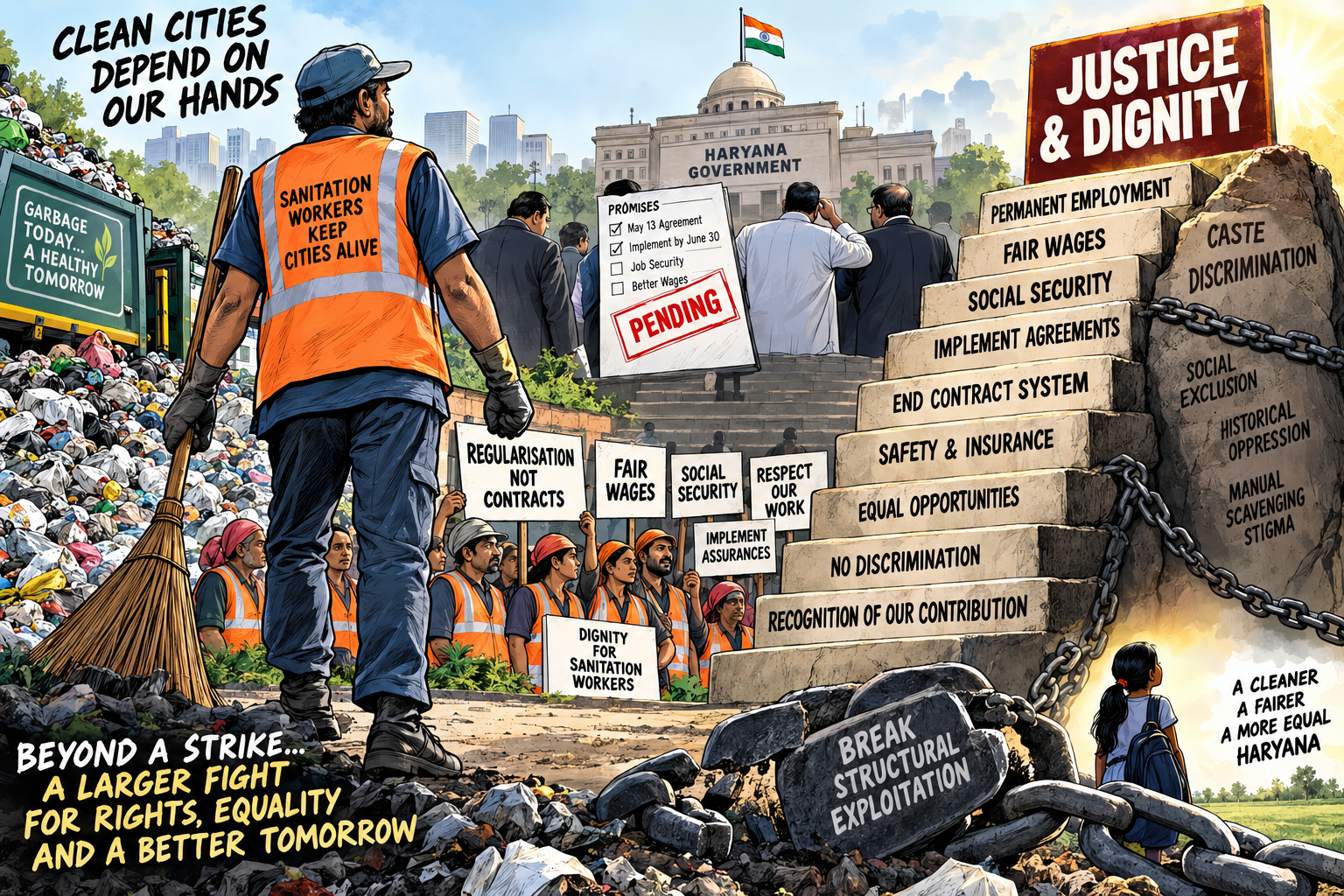
The widening participation of sanitation workers put increasing pressure on the Haryana government. On May 13, the government accepted 17 of the 22 demands raised by the Municipal Employees Association. A major commitment involved the regularisation of contractual employees working in municipalities.
Following the agreement, sanitation workers returned to duty on May 14. The government was given time until June 30 to implement the agreed measures. However, unions subsequently alleged that the commitments had not been implemented adequately. Protests therefore resumed on July 1 and 2.
District-level meetings were held between July 7 and 22 to mobilise workers and build pressure for implementation of the earlier agreement. The unions initially announced a three-day strike from August 6 to 8. After what they described as an unsatisfactory response from the government, the strike was extended indefinitely.
A meeting between sanitation workers and the state government was also held at Haryana Niwas in Chandigarh on July 29. Cabinet minister Krishan Bedi and Urban Local Bodies Minister Vipul Goyal attended the meeting. Bedi faced a particularly sensitive situation, as a significant section of sanitation workers belongs to the Valmiki community. Expectations were therefore placed on him to help persuade the government to resolve the dispute, while the government also expected him to play a role in ending the agitation.
The confrontation subsequently became more intense. On the night of August 25, women sanitation workers protesting in Hisar were reportedly detained around midnight. The incident has raised questions about the legal safeguards governing the arrest of women after sunset under Section 43(5) of the Bharatiya Nagarik Suraksha Sanhita. The provision generally restricts the arrest of a woman between sunset and sunrise except in exceptional circumstances and with prior permission of a first-class magistrate. The reported incident has consequently also triggered a wider discussion about dignity and the constitutional protection of life and personal liberty under Article 21.
The protest took another symbolic turn in Kurukshetra on August 29, when sanitation workers carried out a funeral procession of an effigy of cabinet minister Krishan Bedi before burning it. An earlier meeting between Bedi and workers in Kurukshetra on August 22 had failed to produce a settlement, particularly on the demand for regularisation of contractual employees.
The Haryana Safai Karamchari Commission has also faced criticism from protesting workers. Established to safeguard the rights and interests of sanitation workers, the commission has been questioned by protesters over what they perceive as limited intervention during the ongoing dispute.
On September 4 and 5, protesting workers shaved their heads in another symbolic demonstration. The act was intended to express anger over what they described as attempts to compel them to return to work through pressure and punitive measures rather than through resolution of their outstanding demands.
On September 5, the state government issued directions for sanitation workers to return to duty. However, the order has apparently failed to bring the strike to an end. The protesting workers have maintained that they will continue their agitation until their demands are addressed, with around 13,000 workers reportedly remaining part of the protest.
At the same time, the government has taken a measure that could provide significant relief to a large section of municipal sanitation workers. It has decided to bring 13,093 sanitation workers employed on municipal rolls under the Haryana Contractual Employees (Security of Service) Act, 2024.
Under the announced framework, eligible workers would receive job security up to the age of 60, a monthly risk allowance of ₹2,000, a 15 per cent increase in remuneration, dearness allowance, gratuity, maternity leave and other benefits. Employees who have completed more than 10 years of service would receive monthly remuneration of ₹25,560.
However, the government announcement does not, by itself, resolve the structural questions at the heart of the agitation. The continuing dependence on contractual employment, relatively low-paid labour and uncertainty over long-term employment remain major concerns for workers.
The movement has also expanded its demands for permanent recruitment across a wide range of posts, including peons, masons, gardeners, clerks, drivers, tube-well helpers, electricians, junior engineers, watchmen, bill distributors, tipper and auto drivers, sanitation workers and sanitation inspectors. Other posts mentioned in the demands include assistant sanitation inspectors, chief sanitary inspectors, sanitation health officers, assistant commissioners and chief sanitation and health officers.
However, many employees occupying these categories have not participated in the strike in any substantial manner. This has created a complicated situation in which demands have expanded beyond the immediate occupational concerns of sanitation workers, while participation has remained uneven across different categories.
A similar pattern is visible in the demands concerning employees engaged through the Haryana Kaushal Rozgar Nigam. These include school teachers, computer operators and other contractual employees whose work is not directly connected with sanitation.
The reported involvement of more than one lakh HKRN employees in the broader employment landscape adds another dimension to the debate. Yet, many such employees have continued working and have not joined the sanitation workers’ strike in any substantial manner.
This is where the present agitation assumes a significance beyond a conventional labour dispute.
The 2026 sanitation workers’ movement increasingly reflects a broader contest over the nature of contractual employment and the relationship between workers and the state. It brings sanitation workers, firemen and different categories of contractual employees into a common conversation about job security, wages and social protection.
But there is another dimension that cannot be overlooked: caste.
Sanitation work in India has historically been shaped by caste-based occupational structures. Therefore, any serious examination of the current agitation must recognise that sanitation workers are not simply another category of contractual labour. Their occupational experience is deeply connected with questions of social status, discrimination and dignity.
There is an important distinction here: caste is not merely a division of labour; it is also a division of labourers.
That distinction becomes crucial when the present movement is analysed. The demand for regularisation and fair wages is fundamentally a labour issue, but the demand for dignity in sanitation work also carries a social and caste dimension.
Sanitation workers, therefore, need to carefully examine the range of their demands and maintain particular emphasis on issues directly connected with their profession and community. Such clarity could help create a more focused negotiating framework around regularisation, employment security, implementation of government agreements, fair wages, occupational safety and working conditions.
This does not mean that sanitation workers should isolate themselves from other sections of the working class. On the contrary, solidarity among workers remains important. They can support the legitimate struggles of firemen, teachers, HKRN employees and other contractual workers while simultaneously maintaining a clear focus on their own occupational and community-specific concerns.
Such an approach could strengthen rather than weaken the movement. It would allow sanitation workers to build wider labour solidarity without allowing their own caste-based and occupational concerns to disappear within a much larger set of demands.
The present agitation should therefore not be viewed simply through images of uncollected garbage or disrupted municipal services. Those consequences are visible, but they represent only one part of the story.
At its core lies a more fundamental question: how does a society that has historically assigned sanitation work to particular communities treat the people who continue to perform this essential yet socially undervalued labour?
The answer cannot be limited to temporary wage increases, administrative assurances or orders directing workers to return to duty. It must involve dignity, social security, fair employment practices, occupational safety and credible implementation of commitments already made.
For sanitation workers, the struggle is consequently about much more than employment. It is about recognition, rights, security and dignity.
And any meaningful understanding of that struggle must recognise both dimensions — class as workers and caste as the historical structure that has shaped their occupation.
By:Dr Krishna Kumar..»»»
Scholar of Caste Politics in Haryana | Author of the Springer-published book “Understanding Caste in India: Prejudice, Discrimination and Exclusion”



 Among the other demands were a minimum monthly wage of ₹30,000 for sanitation and sewer workers, financial assistance of ₹20 lakh to the family of a sanitation worker who dies while on duty, and accident insurance of ₹50 lakh for sanitation workers and sewer workers.
 The movement has also expanded its demands for permanent recruitment across a wide range of posts, including peons, masons, gardeners, clerks, drivers, tube-well helpers, electricians, junior engineers, watchmen, bill distributors, tipper and auto drivers, sanitation workers and sanitation inspectors. Other posts mentioned in the demands include assistant sanitation inspectors, chief sanitary inspectors, sanitation health officers, assistant commissioners and chief sanitation and health officers.