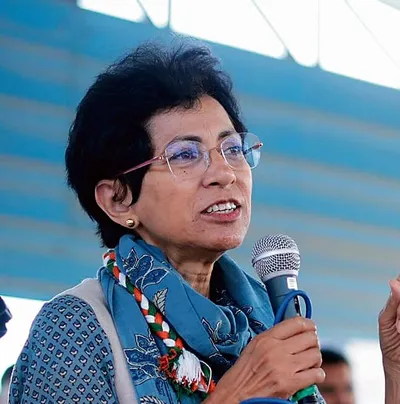
Congress national general secretary and Sirsa MP Kumari Selja speaks on unemployment, inflation, public services and law and order.
Sirsa MP Selja says poor, workers and farmers are facing weakening social and economic security; demands stronger legal rights, accountability and timely compensation
CHANDIGARH | PEN OF DEMOCRACY NEWS DESK
Sirsa Member of Parliament, former Union Minister, Congress General Secretary and Congress Working Committee member Kumari Selja has alleged that the policies of the BJP governments at the Centre and in Haryana have steadily weakened the social and economic security of the poor, workers and farmers.
Raising concerns over changes in the rural employment framework, the ongoing agitation of sanitation and civic service workers in Haryana, and issues related to crop insurance compensation, Selja said that governments must move beyond publicity and ensure that the benefits and legal rights promised to vulnerable sections actually reach them without unnecessary delays, technical hurdles or prolonged struggles.
She said the real test of any development model lies in whether the person standing at the last rung of society is able to receive employment, wages, social security and financial assistance with dignity.
Kumari Selja said that the Congress-led UPA government had enacted the Mahatma Gandhi National Rural Employment Guarantee Act (MGNREGA) in 2005 to provide rural households with a legal right to employment. She said the law was not merely another government welfare scheme but an important instrument linked to the dignity, livelihood and economic security of poor and rural workers.
Referring to the new rural employment arrangement introduced by the Centre from July 2026, Selja said that any new system should be judged on the basis of whether it has strengthened or weakened the right of poor people to demand work and receive employment within a reasonable period.
She said Congress believes that there should be no compromise on the responsibility of the Central Government, adequate budgetary support, transparency or the legal rights of rural workers.
According to Selja, a rural employment programme can be considered effective only when workers are able to access work without facing administrative obstacles and when the system provides sufficient financial support to meet the employment needs of rural families.
She said that the issue is not simply about changing the name or structure of a programme, but about ensuring that the original objective of providing livelihood security to the rural poor remains protected.
“The poor should not have to struggle repeatedly for work that is meant to be their legal and economic right,” she said, stressing that employment programmes must be implemented with adequate funding, transparency and accountability.
Kumari Selja also raised the issue of the ongoing movement by sanitation, sewerage and fire service employees in Haryana.
She said these workers form the backbone of essential public services and play a critical role in maintaining cleanliness, public health and civic infrastructure. According to her statement, sanitation employees have been on protest since August 6 and have continued to demand the implementation of issues on which discussions and understandings were reportedly reached during talks with the government on May 13.
Selja said the state government should address the concerns of the employees through dialogue rather than confrontation.
“The government has a responsibility to find a respectful and practical solution to the legitimate demands of sanitation and other essential service workers,” she said.
She added that the prolonged disruption also affects the general public, as sanitation services are directly connected with public health and the cleanliness of cities and towns.
According to Selja, allowing sanitation workers to remain on a prolonged agitation while residents face the risk of accumulated waste, unhygienic conditions and potential health concerns is not in the interest of either workers or the public.
She said the government should immediately engage with employee representatives, examine the demands seriously and take steps to restore normal sanitation services while ensuring that workers receive fair treatment, proper wages, safety and employment-related rights.
Turning to the issue of agriculture, Kumari Selja questioned the functioning and implementation of the Pradhan Mantri Fasal Bima Yojana, particularly in cases where farmers face difficulties in receiving timely information, crop surveys and compensation after suffering losses.
She said that a farmer who has paid an insurance premium should clearly know which insurance company is responsible for his or her area, where crop damage must be reported, when the survey will be conducted and within what timeframe compensation is expected to be provided.
Selja referred to the Haryana government’s existing guidelines regarding crop-loss reporting and said that farmers are expected to report crop damage within a specified period, following which the insurance company and the Agriculture Department are required to undertake the necessary assessment process.
However, she said that if farmers continue to face confusion over the responsible insurance company, survey procedures or insurance claims, then serious questions arise regarding the effectiveness of the system.
“The basic purpose of crop insurance is to provide financial protection to farmers during natural disasters and crop losses, not to force them into complicated technical procedures and repeated visits to government offices,” Selja said.
She demanded greater accountability from insurance companies and concerned departments. According to her, details of the insurance company and responsible officials for every district should be publicly available so that farmers know exactly whom to contact in case of crop damage.
She further demanded that crop-loss surveys should be conducted in a transparent manner and completed within a clearly defined timeframe. Once the loss has been assessed, appropriate compensation should be transferred directly to the farmer’s bank account without unnecessary delays, she said.
Selja maintained that the concerns of farmers cannot be addressed merely through announcements and policy documents. She said the success of any crop insurance programme depends on how quickly and fairly a farmer receives financial assistance after suffering a genuine loss.
Highlighting Congress’ position, the Sirsa MP said that the party has consistently supported the protection of the rights of the poor, farmers and workers.
She said that rural families should receive employment with dignity, sanitation workers should receive fair wages, workplace safety and their due rights, while farmers should get complete, timely and transparent compensation for crop losses.
According to Selja, development has real meaning only when the benefits of governance reach the most vulnerable sections without forcing them to protest, struggle or run from one office to another.
She said the Centre and Haryana governments must create a more accountable and responsive system in which the poor, workers and farmers feel socially and economically secure.
“Governance should not remain limited to publicity and announcements. The real responsibility of the government is to ensure that every entitled citizen receives his or her rights with dignity and without unnecessary hardship,” she said.
Selja added that employment security, labour rights and agricultural protection are interconnected issues and require a people-centred approach. A strong system, she said, should provide rural workers with meaningful employment opportunities, essential service workers with dignity and protection, and farmers with reliable support when crops are damaged.
She called upon the governments at the Centre and in Haryana to strengthen accountability, improve transparency and ensure that policies designed for the poor, workers and farmers are implemented effectively at the ground level.