pen of democracy ads top
Home Haryana Samadhan Shivirs in Yamunanagar to Be Held Twice a Week for Faster...

Samadhan Shivirs in Yamunanagar to Be Held Twice a Week for Faster Grievance Redressal

6
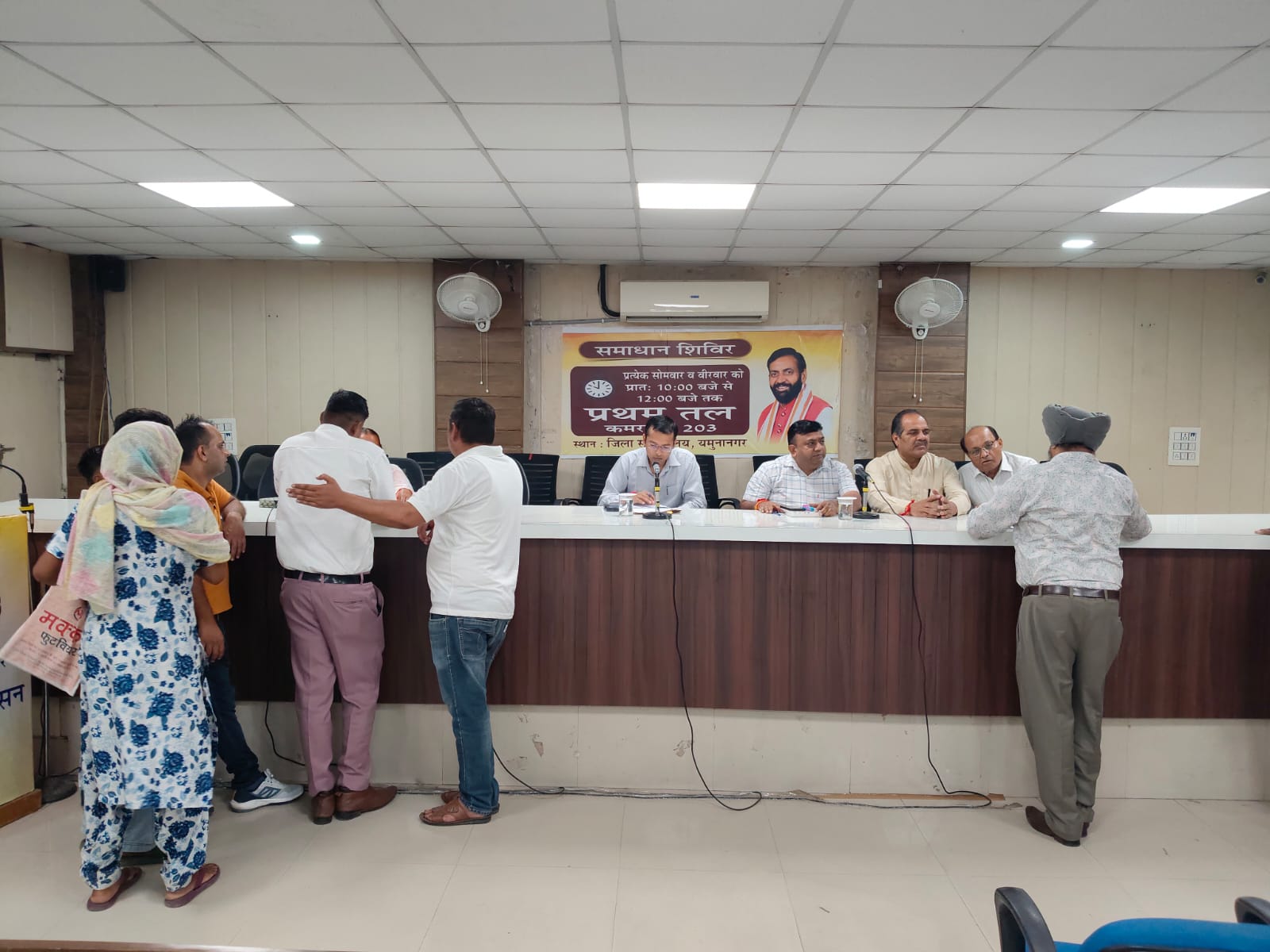
CTM Piyush Gupta hearing public grievances during a Samadhan Shivir in Yamunanagar.
CTM Piyush Gupta listens to public grievances during a Samadhan Shivir at the District Secretariat in Yamunanagar.

CTM Piyush Gupta directs officials to make every effort to resolve public complaints at the earliest and ensure time-bound disposal of matters requiring verification or documents


PEN OF DEMOCRACY NEWS DESK
YAMUNANAGAR


City Magistrate (CTM) Piyush Gupta has directed officials to make every possible effort to resolve the grievances of citizens visiting the Samadhan Shivirs at the earliest and ensure that complaints requiring documents, verification or other administrative procedures are also disposed of within a fixed timeframe.

Gupta said the Haryana government has revised the schedule of the Samadhan Shivirs being organised to provide citizens with a direct and convenient platform for the speedy resolution of their grievances. Under the revised arrangement, the Samadhan Shivirs will now be held twice a week, on Mondays and Thursdays, from 10 am to 12 noon. The camps will continue to be organised at both district and sub-divisional levels.

The CTM was speaking while presiding over a Samadhan Shivir organised in the auditorium of the District Secretariat. During the camp, six complaints were received from residents concerning different civic, administrative and personal matters.

Yamunanagar resident Ankit Kumar approached the Samadhan Shivir seeking correction of his Property ID and resolution of an electricity bill-related issue. Pankaj Sharma of Gulab Nagar raised a complaint regarding alleged failure to take legal action. Jai Shankar of Yamunanagar sought correction of his income details in the Parivar Pehchan Patra.

Nisha Rani of Khurdi raised a complaint concerning an alleged assault and demand for dowry, while Jaswinder Kaur of Satgauli complained that the concerned Patwari had not recorded an intqal.

Gupta directed the concerned officials to examine the complaints and take necessary action in accordance with the applicable rules. He stressed that whenever a grievance can be resolved at the Samadhan Shivir itself, every effort should be made to dispose of it on the spot.

He further said that if the resolution of a complaint depends upon verification, supporting documents, field inspection or another administrative procedure, the concerned department must ensure that the matter is processed and resolved at the earliest within the prescribed timeframe.

The CTM emphasised that the purpose of the Samadhan Shivirs is not merely to receive complaints but to provide an effective mechanism through which citizens can obtain timely solutions to their genuine problems. He said people should not be forced to repeatedly visit different government offices for matters that can be addressed through proper coordination among departments.

Gupta also stressed the importance of informing complainants clearly whenever additional documents or information are required. Such communication, he said, can prevent unnecessary delays and enable departments to process cases more efficiently.

The CTM directed officials to take public grievances seriously and maintain proper follow-up on complaints requiring action beyond the Samadhan Shivir. Departments were also asked to ensure that cases involving verification or other formalities do not remain pending unnecessarily.

He said regular Samadhan Shivirs provide citizens with an opportunity to interact directly with government officials and bring their concerns before the administration. The revised schedule, under which the camps will be conducted twice every week, is expected to provide residents with more frequent opportunities to seek assistance.

The Samadhan Shivirs will be held every Monday and Thursday from 10 am to 12 noon at the district and sub-divisional levels. Citizens can approach the appropriate Samadhan Shivir with their genuine grievances and seek intervention from the concerned departments.

The administration has placed emphasis on timely disposal, accountability and citizen convenience. Officials have been instructed to ensure that the grievances received through the Samadhan Shivirs are dealt with according to established procedures and that unnecessary delays are avoided.

Gupta said administrative efficiency depends not only on receiving complaints but also on ensuring that appropriate action follows. Where an issue cannot be resolved immediately, the concerned officials must complete the required process within the prescribed timeframe.

The CTM’s directions are aimed at strengthening the grievance redressal mechanism and ensuring that citizens receive responsive services from government departments. The administration expects officials to work in coordination so that genuine public complaints are resolved efficiently.

The six complaints received during the Samadhan Shivir covered issues relating to Property ID, electricity bills, legal action, income details in the Parivar Pehchan Patra, an alleged assault and dowry demand, and non-recording of an intqal by a Patwari.

The administration said such direct interaction with citizens also helps officials understand problems at the ground level and take corrective measures. Regular monitoring of complaints can further help identify recurring administrative issues and improve the delivery of public services.

Gupta reiterated that citizens should not have to move from one office to another repeatedly for legitimate work. Wherever immediate disposal is possible, officials should make every effort to resolve the matter at the Samadhan Shivir. In cases requiring verification or documentation, the process should be completed without avoidable delay.

The special members present at the Samadhan Shivir included Khareti Lal Batra, Neeraj Gupta and Surendra Sharma, along with officials from various departments.

The administration has appealed to residents to make effective use of the Samadhan Shivirs and bring their genuine grievances before the appropriate authorities. Officials have also been instructed to provide necessary assistance to citizens and ensure that the objective of the Samadhan Shivir is achieved through prompt and time-bound action.

The revised arrangement of holding Samadhan Shivirs twice a week is expected to strengthen public access to the administration and create a more regular channel for grievance redressal. By providing fixed days and timings, the administration aims to make it easier for citizens to approach officials regarding issues requiring government intervention.

The initiative also places greater responsibility on government departments to ensure that complaints do not remain unresolved after being received. Officials will have to examine the nature of each grievance and determine whether it can be settled immediately or requires further verification and documentation.

The CTM said that the administration’s priority is to make grievance redressal more efficient and citizen-oriented. He directed all concerned officials to perform their responsibilities seriously and ensure that genuine complaints receive appropriate attention.

The Samadhan Shivirs will therefore continue to provide an important platform for direct interaction between citizens and the administration in Yamunanagar. With the revised twice-weekly schedule, residents will have more regular opportunities to raise their concerns, while officials will be expected to ensure speedy, transparent and time-bound disposal of grievances.


National Lok Adalat in Yamunanagar on September 12 to Take Up Eligible Pending Cases


The District Legal Services Authority, Yamunanagar, will organise the third National Lok Adalat on September 12, 2026, providing litigants an opportunity to settle eligible pending cases through mutual agreement and consent.

District Legal Services Authority Secretary and Chief Judicial Magistrate Sumitra Kadian said the National Lok Adalat would take up various categories of cases that can legally be resolved through compromise. She appealed to eligible litigants to make use of the facility for faster and more accessible settlement of their disputes.

The National Lok Adalat will consider compoundable criminal offences, cases under Section 138 of the Negotiable Instruments Act, bank recovery matters, Motor Accident Claims Tribunal (MACT) cases and matrimonial disputes.

Kadian said labour disputes, land acquisition matters and pending electricity and water bill-related cases would also be taken up, subject to their eligibility for settlement under the applicable legal provisions.

She clarified that non-compoundable theft cases will not be included in the Lok Adalat. The forum will deal with cases where settlement through mutual consent is legally permissible.

Service matters concerning salaries, allowances and revision benefits, along with revenue matters, will also be eligible for consideration. Other civil disputes, including matters concerning rent, easementary rights and injunctions, can also be settled through mutual agreement where legally permissible.

The National Lok Adalat is intended to provide litigants with an alternative mechanism for resolving disputes without prolonged litigation. Since eligible cases are settled on the basis of consent between the parties, the process can help reduce the time and expense involved in continuing lengthy court proceedings.

The District Legal Services Authority said parties whose cases fall within the eligible categories can approach the concerned legal services authorities and court officials for information regarding the procedure for placing their matters before the National Lok Adalat.

The Lok Adalat mechanism is based on compromise and mutual agreement. Unlike conventional litigation, where parties may continue proceedings through different stages, the Lok Adalat provides an opportunity to resolve disputes amicably when both sides are willing to reach a settlement.

Kadian said the initiative would help eligible litigants obtain speedy resolution of disputes while reducing the burden associated with prolonged litigation. She encouraged concerned parties to explore settlement wherever their cases fall within the categories permitted under law.

Bank recovery and cheque dishonour cases are among the matters expected to benefit from the settlement mechanism, while MACT and matrimonial disputes can also be considered where the legal requirements for compromise are fulfilled.

Electricity and water bill disputes and certain labour-related matters will also be taken up, providing concerned parties with an opportunity to resolve issues through an agreed settlement.

The authority will also facilitate settlement of eligible civil matters, including rent-related disputes, easementary rights and injunction cases. Revenue and specified service-related matters can similarly be considered under the applicable provisions.

The District Legal Services Authority has emphasised that parties should approach the appropriate authority in advance if they wish their matters to be considered in the National Lok Adalat. The concerned officials can guide litigants regarding the eligibility and procedure applicable to their cases.

The September 12 National Lok Adalat forms part of the broader legal services system aimed at making justice more accessible and encouraging amicable settlement of disputes. It provides an opportunity for parties to resolve eligible matters through dialogue and consent rather than continuing adversarial proceedings.

Officials said the initiative can particularly benefit litigants seeking resolution of matters where both sides are prepared to reach a mutually acceptable settlement. The process is designed to provide an accessible avenue for resolving eligible disputes while helping parties save time and litigation-related expenses.

The District Legal Services Authority has urged citizens with pending eligible cases to take advantage of the National Lok Adalat and seek information about the settlement process from the concerned legal services authorities.


POD/DESK
error: Content is protected !!