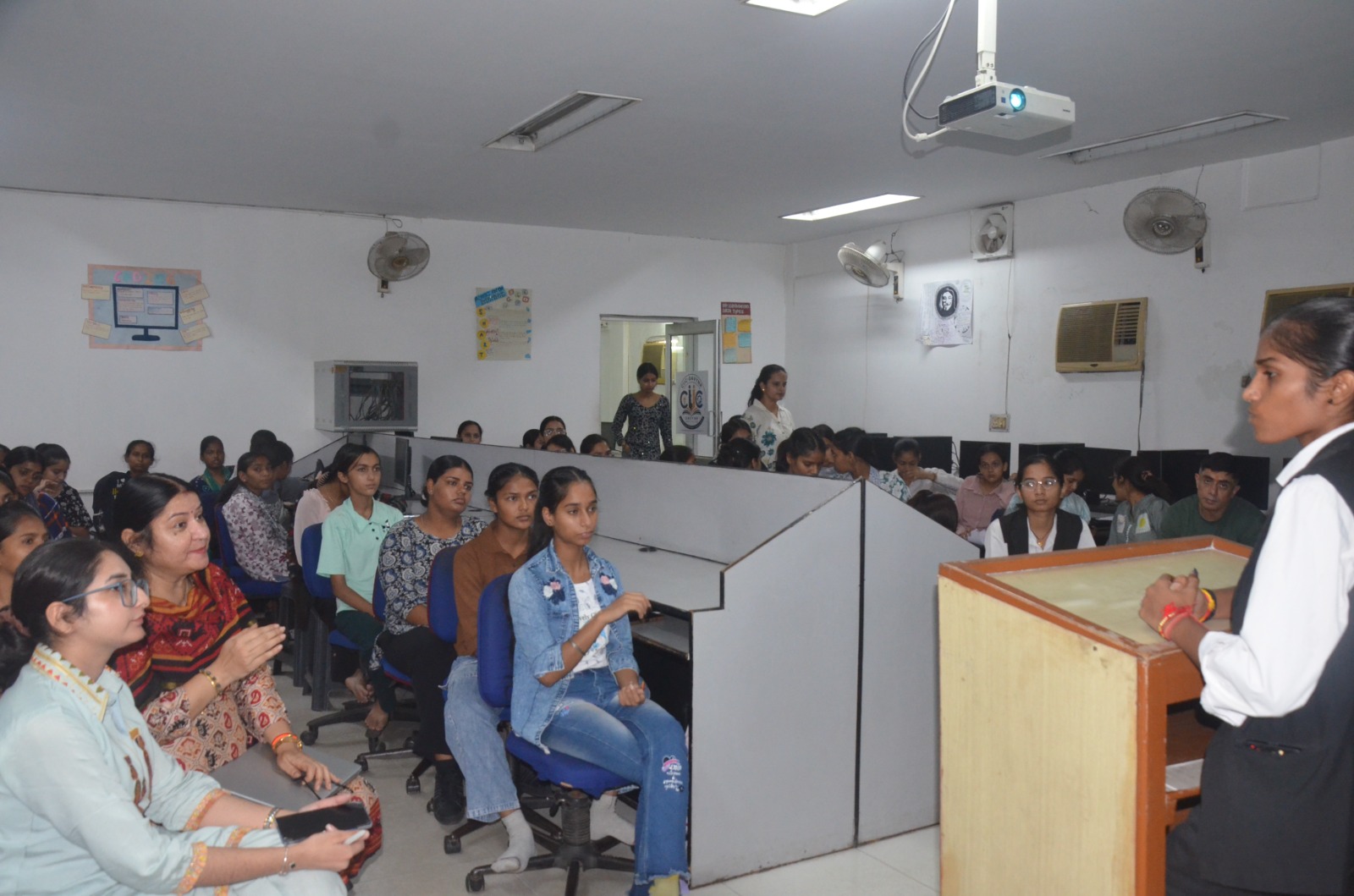
Students present innovative startup ideas during the Inter-Institutional Startup Competition organised at DAV Girls College, Yamunanagar.
14 Teams Present Innovative Business Ideas Focused on Solving Everyday and Social Problems; MA English Students Win First Position
PEN OF DEMOCRACY NEWS DESK YAMUNANAGAR
DAV Girls College organised an Inter-Institutional Startup Competition under the joint aegis of the college’s Institution’s Innovation Council (IIC) and the Campus Innovation and Incubation Centre, with the objective of nurturing innovation, creativity, problem-solving abilities and an entrepreneurial mindset among students.
The competition provided students with a platform to transform their observations about everyday challenges and social issues into practical business ideas. The event was presided over by IIC Vice-President Dr. Sunita Kaushik and Convener Vivek, who encouraged the participating students to approach problems from an innovative perspective and explore entrepreneurship as a viable career pathway.
A total of 14 teams representing the Computer Science, Arts, Commerce and Science departments participated in the competition. The students presented a diverse range of innovative business concepts aimed at addressing practical challenges faced by individuals, communities and society at large. The presentations reflected the participants’ efforts to combine creativity with commercial viability and social usefulness.
Among the ideas presented by the students were a platform designed to address civic problems, an animal rescue service, amla and aloe vera juice production, a nutritious tiffin service, customised gift packages, agriculture-based products, organic skincare solutions, an online fashion business and organic manure production.
The competition was designed not merely to test the originality of ideas but also to encourage students to think about how their concepts could eventually be developed into sustainable ventures. Participants were therefore expected to demonstrate an understanding of the problem they intended to address, the proposed solution, its potential users and the possibility of turning the idea into a practical business model.
The participating teams were evaluated on several parameters, including innovation, creativity, feasibility, problem-solving ability, business potential and presentation skills. The evaluation process focused on the overall strength of each idea as well as the students’ ability to explain their concepts clearly and convincingly.
The judging panel comprised Innovation Ambassadors Mamta Thapar and Vaishali, along with Mukul Gujral, founder of Amritansh Solution, Ambala. The judges interacted with the participants and assessed their presentations from the perspective of innovation as well as practical implementation.
The jury members appreciated the range of ideas presented by the students and offered valuable suggestions to help them improve their concepts. The feedback focused on the importance of understanding market requirements, identifying the target audience, assessing feasibility and developing innovative ideas into workable solutions.
The competition also highlighted the growing importance of entrepreneurship and innovation in higher education. By providing students with opportunities to develop and present startup ideas, institutions can help them move beyond conventional academic learning and develop skills that are increasingly relevant in a changing professional environment.
Students from different academic disciplines brought different perspectives to the competition. Ideas related to civic problem-solving and animal rescue reflected a focus on social needs, while concepts involving organic products, agricultural goods and nutritional services demonstrated an interest in health, sustainability and local opportunities. Similarly, online fashion and customised gift businesses reflected the participants’ understanding of changing consumer preferences and digital commerce.
The event also encouraged students to look at familiar problems differently. Rather than simply identifying challenges, the participants were encouraged to explore how those challenges could become opportunities for innovation and entrepreneurship. Such an approach can help students develop confidence in their ability to conceptualise, communicate and potentially implement their own ideas.
In the final results, the team comprising MA English final-year students Amrit Kaur and Sonal secured the first position. Their performance was recognised for the strength of their presentation and the overall quality of their business idea.
Akshi, a BSc Biotechnology first-year student, secured the second position in the competition. Her achievement reflected the participation of students from different academic levels and disciplines and demonstrated that innovative thinking can emerge at an early stage of higher education.
The organisers said that such competitions provide students with valuable exposure to the various stages involved in developing an entrepreneurial idea. From identifying a problem and designing a solution to assessing feasibility and presenting a business proposition, the process enables students to develop multiple skills simultaneously.
The event also reinforced the role of innovation centres and institutional entrepreneurship initiatives in creating an environment where students can experiment with new ideas. Academic institutions can play an important role in helping students understand that entrepreneurship is not limited to starting a conventional business but can also involve developing technology-driven solutions, social enterprises, sustainable products and services addressing community needs.
The organisers emphasised the importance of continuing to provide students with opportunities to participate in innovation-focused activities. Regular competitions, workshops, mentoring sessions and incubation support can help promising ideas move from the conceptual stage towards practical implementation.
The programme also gave students an opportunity to learn from the feedback of professionals and innovation experts. Interaction with judges enabled participants to understand the difference between an attractive idea and a feasible business proposition. Such exposure can help students refine their concepts and develop a more structured approach towards entrepreneurship.
The successful conduct of the competition was supported by Dr. Parmesh Kumar, Jasmeet Kaur and Shaily Chauhan, whose contribution helped facilitate the event.
The organisers said the initiative was aimed at creating a culture in which students feel encouraged to question existing practices, identify problems and develop innovative solutions. They added that fostering creativity and entrepreneurship among young people is important not only for individual career development but also for generating new ideas, businesses and employment opportunities.
The Inter-Institutional Startup Competition thus served as a platform for students to showcase their creativity while gaining practical exposure to entrepreneurship, business planning and innovation. With 14 teams presenting ideas across diverse sectors, the programme reflected the growing interest among students in exploring entrepreneurship as a means of creating solutions and building future career opportunities.
The organisers expressed hope that the participating students would continue developing their ideas beyond the competition and use the feedback received from the judges to strengthen their concepts. The initiative also encouraged students to view innovation as an ongoing process and entrepreneurship as a pathway through which knowledge and creativity can be converted into meaningful solutions for society.