District-level Panchayat Conference held at Zila Parishad office; Panchayat representatives briefed on 125-day employment guarantee and sustainable rural development
YAMUNANAGAR / PEN OF DEMOCRACY NEWS DESK
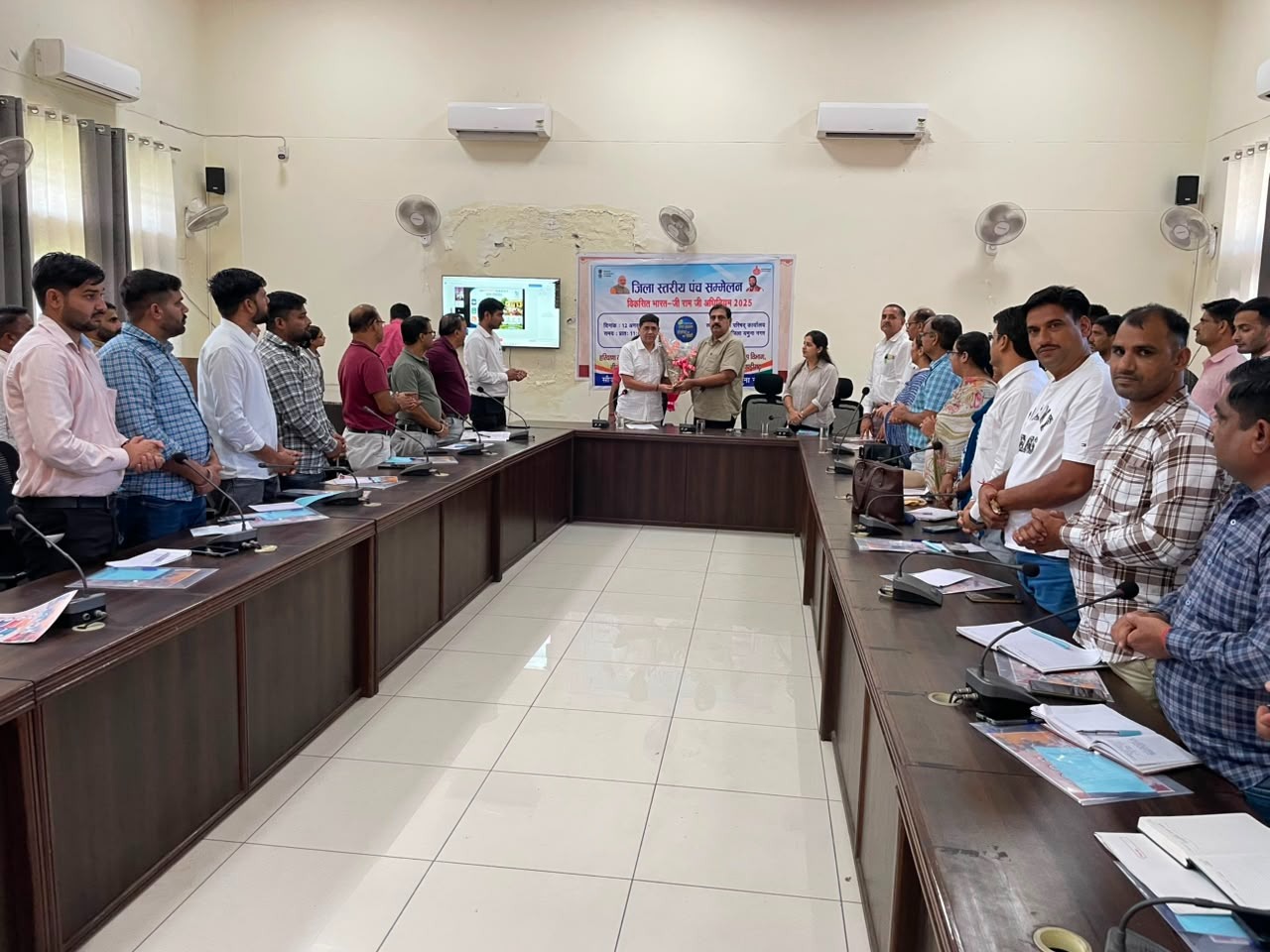
A district-level Panchayat Conference under the Viksit Bharat Guarantee for Rozgar and Aajeevika Mission-Gramin (VB-G RAM G) was organised at the Zila Parishad office under the chairmanship of Additional Deputy Commissioner Naveen Ahuja, bringing together Panchayat representatives, Gram Sachivs, officials and field staff to discuss the objectives and implementation of the rural employment and livelihood scheme.
The conference focused on creating greater awareness among elected Panchayat representatives and grassroots-level functionaries about the provisions of the scheme, its employment guarantee component and its broader objective of strengthening rural livelihoods through sustainable development works.
At the beginning of the programme, Jaswinder Singh, Deputy Chief Executive Officer of the Zila Parishad, welcomed Additional Deputy Commissioner Naveen Ahuja by presenting him with a bouquet.
During the conference, Dr Virender Singh Chauhan, Director, Haryana Institute of Rural Development (HIRD), Nilokheri, Karnal, addressed the participants through video conference. He provided detailed information about the VB-G RAM G framework and explained the principal objectives of the scheme to Panchayat representatives, Gram Sachivs, district and block-level staff and other officials.
Resource person Mahak Saini, representing HIRD Nilokheri, subsequently briefed the Sarpanches, Gram Sachivs and other officials and employees present at the conference about the practical aspects of the scheme.
According to the information shared during the programme, the Viksit Bharat Guarantee for Rozgar and Aajeevika Mission-Gramin, or VB-G RAM G Act, 2025, has been introduced with the broader objective of achieving the vision of a developed India by 2047. The scheme came into effect in rural areas from July 1, 2026, as stated during the conference.
One of the key features discussed at the programme was the provision of a statutory employment guarantee for eligible rural households. Under the scheme, adult members of eligible rural families willing to undertake unskilled manual work are entitled to 125 days of guaranteed employment in each financial year.
Addressing the conference, Additional Deputy Commissioner Naveen Ahuja said the objective of VB-G RAM G extends beyond providing employment to rural households.
He said employment under the scheme is intended to contribute towards strengthening rural livelihoods, creating durable community assets and accelerating the overall and sustainable development of villages.
Ahuja said that rural development should not be viewed only from the perspective of employment generation. According to him, employment-linked development works can simultaneously address infrastructure requirements, improve natural resource management and create assets that continue to benefit rural communities over the long term.
He also said that workers are being provided a wage of Rs 409 per day, which, according to the information shared at the conference, is among the highest such wage rates across the states.
The Additional Deputy Commissioner highlighted several priority areas under the scheme. These include water conservation, development of essential rural infrastructure, creation of livelihood-related assets and works aimed at addressing extreme weather and climate-related challenges.
He said these activities are intended to be planned and implemented in an integrated manner so that employment generation is accompanied by the creation of useful and durable infrastructure in villages.
Water conservation was highlighted as one of the important components of the programme. Works related to ponds, water conservation structures and other rural water-management facilities can help strengthen local resources while also providing employment opportunities to eligible rural workers.
Similarly, the creation of basic rural infrastructure and livelihood-related assets can help communities improve their economic opportunities and reduce gaps in village-level facilities.
Ahuja said the scheme seeks to create a stronger connection between employment generation and long-term village development.
He explained that when rural employment is linked with the creation of productive and durable assets, the benefits of public investment can extend beyond the immediate period of employment.
The conference also emphasised the importance of active participation by Panchayats in identifying local development priorities.
Panchayat representatives were encouraged to understand the provisions of the scheme properly so that works can be planned according to the actual needs of their villages.
The role of Sarpanches, Panchayat Samiti members and Gram Sachivs was discussed as particularly important because these grassroots-level functionaries remain closely connected with rural communities.
They can help identify genuine local requirements, communicate scheme provisions to residents and facilitate the implementation of approved development works.
The conference also stressed the importance of convergence among different development programmes.
According to officials, the broader objective of VB-G RAM G is to promote empowerment, development, convergence of schemes and saturation, while making better use of resources available in rural areas.
Such an approach is intended to ensure that development activities do not remain isolated interventions but contribute collectively to improving the quality of life in villages.
The scheme is also expected to support works related to climate resilience and extreme weather conditions. Officials said that with changing weather patterns creating new challenges for rural communities, development planning needs to take into account the need for stronger and more resilient local infrastructure.
The focus on water conservation and climate-related works is therefore being viewed as an important part of sustainable rural development.
During the conference, participants were also informed about the need for greater awareness at the village level. Panchayat representatives and field officials were encouraged to communicate the provisions of the scheme to eligible rural families so that beneficiaries can understand their employment rights and available opportunities.
The programme also provided an opportunity for participants to seek greater clarity about the implementation framework and responsibilities of different stakeholders.
The officials said that effective implementation at the grassroots level would be essential for ensuring that the benefits of the scheme reach eligible rural households.
Ahuja said that strong Panchayats are essential for building self-reliant and developed villages. When local institutions understand development programmes and actively involve residents in planning and implementation, development works can become more responsive to local requirements.
He said the ultimate objective is to create villages that are economically stronger, better equipped with basic infrastructure and capable of making effective use of available resources.
The conference concluded with an emphasis on coordinated implementation, awareness among Panchayat representatives and effective delivery of the scheme at the village level.
The administration said that employment security combined with durable asset creation can provide a stronger foundation for rural development.
The programme was attended by Naresh Dhillon, Executive Engineer, Zila Parishad; all Panchayat Samiti chairpersons; Sarpanches; Gram Sachivs; district and block-level VB-G RAM G staff; and other officials and employees.
The conference provided the participating representatives with detailed information about the objectives, provisions and implementation aspects of VB-G RAM G and underlined the role of Panchayati Raj institutions in translating the rural development vision into practical outcomes at the village level.
National Lok Adalat in Yamunanagar on September 10 to Resolve Public Utility Disputes
The District Legal Services Authority has announced that a National Lok Adalat will be organised in Yamunanagar on September 10, 2026, providing citizens an opportunity to seek speedy and amicable settlement of disputes without the financial burden generally associated with prolonged legal proceedings.
The Lok Adalat will focus on disputes relating to banks, financial institutions and public utility services, and will be held at the Permanent Lok Adalat located in the Alternative Dispute Resolution (ADR) Building on the court premises.
District Legal Services Authority Secretary and Chief Judicial Magistrate Sumitra Kadian said the Lok Adalat is intended to provide a simple, accessible and speedy mechanism for resolving disputes through mutual settlement.
She said Lok Adalat proceedings provide an opportunity for parties involved in a dispute, as well as those facing a potential dispute, to seek an amicable resolution without unnecessary delay.
According to the District Legal Services Authority, one of the major advantages of the process is that eligible matters can be taken up without any court fee, thereby making dispute resolution more accessible to ordinary citizens.
CJM Sumitra Kadian said the initiative has been undertaken in accordance with the directions of the Haryana State Legal Services Authority, Panchkula, and that citizens with eligible disputes are being encouraged to make use of the facility.
The National Lok Adalat is scheduled to begin at 10 am on September 10, 2026 at the Permanent Lok Adalat in Yamunanagar-Jagadhri.
The authorities have also specified a deadline for filing applications. Any party connected with a dispute covered under the relevant provisions may submit an application to the Permanent Lok Adalat (Public Utility Services), Yamunanagar, Jagadhri, under Section 22-C of the Legal Services Authorities Act, 1987, without payment of court fee.
Applications can be submitted up to September 1, 2026, allowing eligible parties time to approach the forum and seek settlement before the National Lok Adalat.
The District Legal Services Authority has appealed to citizens who are facing disputes related to covered public utility services or financial matters to make use of the opportunity rather than allowing disputes to remain unresolved for long periods.
Lok Adalats are designed around the principle of settlement through mutual understanding. Instead of focusing solely on an adversarial contest between parties, the process encourages both sides to arrive at an acceptable resolution.
This can be particularly useful in cases where the parties are willing to settle their differences but require an appropriate legal forum to facilitate the process.
The Permanent Lok Adalat mechanism is particularly relevant for disputes concerning public utility services, where timely resolution can be important for individuals as well as service providers.
The authorities said that eligible parties can approach the Permanent Lok Adalat with their grievances and seek appropriate relief under the applicable legal provisions.
The initiative is also expected to reduce the burden associated with prolonged litigation in suitable matters.
For citizens, the availability of a settlement mechanism can provide an opportunity to resolve disputes more conveniently and avoid unnecessary delays.
The District Legal Services Authority has emphasised that people should first ascertain whether their particular dispute falls within the jurisdiction and scope of the Permanent Lok Adalat before submitting their application.
The upcoming National Lok Adalat is therefore being presented as an opportunity for eligible parties to seek a mutually acceptable settlement in a structured legal environment.
CJM Sumitra Kadian said parties involved in disputes or potential disputes are welcome to approach the forum for resolution of their grievances.
The authorities have also made arrangements for citizens seeking additional information or assistance. People can contact the designated numbers for guidance regarding the process and other relevant details.
For assistance, citizens can contact 93065-37007 or 95188-54568.
The District Legal Services Authority has encouraged eligible citizens to take timely action instead of waiting until the last moment, particularly because applications for matters covered under Section 22-C can be submitted only up to September 1 for the scheduled September 10 proceedings.
The announcement comes at a time when accessible dispute-resolution mechanisms are increasingly important for citizens who may otherwise face difficulties in navigating lengthy legal procedures.
The Lok Adalat model seeks to combine legal validity with an emphasis on settlement and cooperation. Where parties are willing to resolve their dispute mutually, the process can provide an effective alternative to prolonged litigation.
The Yamunanagar National Lok Adalat will consequently provide an important opportunity to eligible parties dealing with disputes involving banks, financial institutions and public utility services.
The District Legal Services Authority has urged citizens to understand the scope of the forum and approach the Permanent Lok Adalat with appropriate applications within the prescribed timeline.
The administration and legal services authorities have reiterated that the objective is to provide citizens with a convenient and accessible avenue for dispute resolution.
With the hearing scheduled for September 10 at 10 am, eligible parties have several weeks to prepare their applications and seek necessary information.
The authorities have also stressed that the process is intended to provide relief through amicable settlement, helping parties resolve their grievances without unnecessarily prolonging disputes.
Citizens requiring clarification about eligibility, filing procedure or other aspects of the process can contact the numbers provided by the District Legal Services Authority.
The National Lok Adalat at Yamunanagar thus offers eligible litigants and potential litigants an opportunity to pursue a settlement-oriented resolution in a transparent and legally recognised forum.
The District Legal Services Authority has appealed to all eligible parties to make use of the facility and approach the Permanent Lok Adalat within the stipulated deadline.
POD/DESK