POD»
Yamunanagar Administration Tightens School Monitoring to Strengthen Foundational Learning
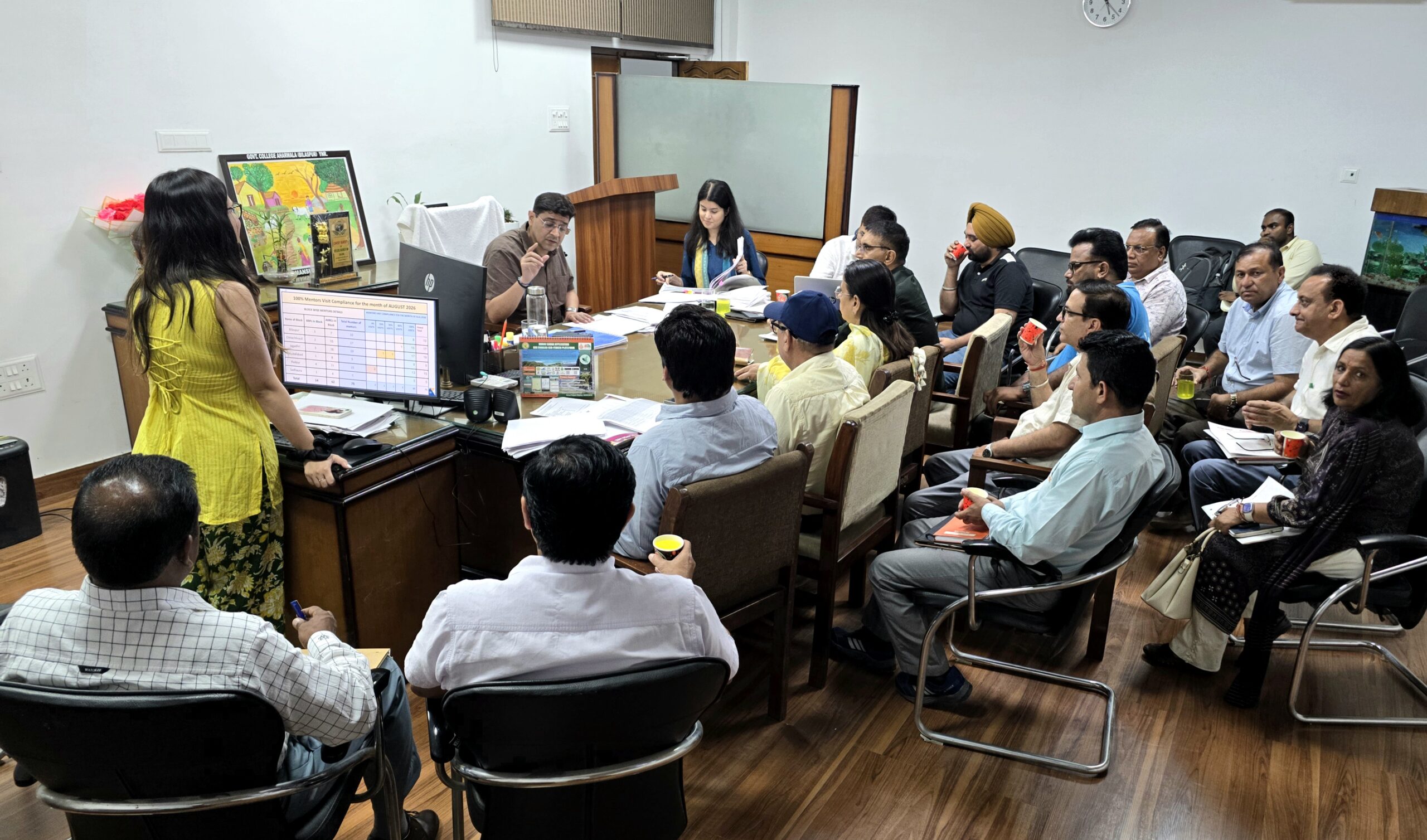
The Yamunanagar district administration has stepped up monitoring of elementary education to strengthen the implementation of the National Education Policy (NEP) 2020 and the NIPUN Bharat Mission. An important review meeting of the district-level District Project Implementation Unit (DPIU) was held under the chairmanship of Additional Deputy Commissioner Naveen Ahuja to assess foundational literacy and numeracy (FLN) and the progress of NIPUN-grade classrooms in primary schools across the district.
Addressing the meeting, Ahuja said the education system can be considered meaningful only when its benefits reach children at the last mile.
He directed officials and teachers to focus on measurable improvement on the ground rather than relying merely on paperwork, formal compliance or numerical reporting.
Progress Reviewed Through Presentation »
District NIPUN Coordinator Sanjeev Saini and Anjali Singh, representing the State Academic Cell (SPIU), presented an updated review of programmes being implemented in primary schools.
Through a detailed presentation, they shared information on achievements, learning quality and the current status of foundational learning initiatives across the district.
45-Day Remedial Teaching Plan »
Officials were directed to undertake a cluster-wise and school-wise analysis of performance in the first periodic assessment (PA-1).
Schools were asked to identify subjects and competencies in which students were lagging and begin a focused 45-day remedial teaching programme with immediate effect. Schools recording results below 50 per cent will undergo separate review.
Saturday Inspections and School Adoption »
District and block-level officials have been instructed to make mandatory school visits on Saturdays.
Officials will formally adopt schools in remote, border and geographically challenging areas, as well as low-performing capsule schools, so that intensive mentoring and regular monitoring can be ensured.
Attendance Verification and Mentor Accountability »
During inspections, both digital and physical attendance records of teachers and students will be checked.
The administration has taken note of a reported instance at Government School Sarawan where attendance had not been recorded by 10 am and ordered that an explanation be sought from the concerned school head.
Accountability measures were also discussed for mentors and monitors who had not visited even a single school during the month.
Written explanations are to be sought from such zero-visit personnel, while compliance reports relating to incomplete or brief visits were sought by September 26. Additional visits and completion of spot-assessment targets were also emphasised.
Teachers to Be Deputed Where Shortages Persist »
To prevent disruption to learning in schools facing serious teacher shortages, officials were directed to arrange temporary deputation of teachers wherever required. The measure is intended to address staffing gaps and ensure that students continue to receive regular classroom instruction.
Block-Specific Strategies and Data Reverification »
A block-specific approach was also outlined. In Chhachhrauli, special remedial classes will be arranged in view of weak mathematics performance.
In Radaur, officials will examine the reasons behind a decline in Parent App activation from 68 per cent to 39 per cent and conduct data reverification. Clusters with four to five or fewer schools will be brought under the Capsule-2 monitoring protocol for closer supervision.
AI Tools to Support Reading Assessment »
Modern artificial intelligence tools will be used to measure children’s oral reading fluency (ORF). Students will also be given regular practice through previous ASER assessment worksheets so that they become familiar with assessment formats and approach future evaluations with greater confidence and less anxiety.
Parent Participation and Fortnightly Teacher Interaction »
A district-level mega teacher-parent meeting will be organised to connect parents more closely with children’s learning progress.
In addition, virtual meetings through Google Meet will be held every fortnight with primary and upper-primary teachers so that ground-level difficulties can be identified and addressed quickly.
At the conclusion of the meeting, District Education Officer Premlata and District Elementary Education Officer Ashok Kumar Rana assured the Additional Deputy Commissioner that the decisions taken would be implemented with commitment.
The administration’s measures are aimed at strengthening foundational learning, improving monitoring and ensuring that corrective action reaches schools and students where it is most needed.
District Project Coordinator Karnail Singh, Deputy District Education Officer Shiv Kumar and Block Education Officers Ashok Dhiman, Naresh Pal, Sunita Devi, Dharam Singh Rathi and Inderraj Singh were among those present. Representatives of the State Academic Cell, including Anant, Satyadev, Sukhwinder and Suresh Kumar, also attended the meeting.