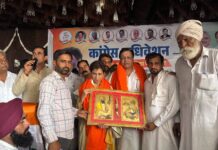
Sirsa MP Selja says true respect for sanitation workers lies in securing their livelihood, ensuring regular employment and addressing their legitimate demands through dialogue
CHANDIGARH | PEN OF DEMOCRACY NEWS DESK
Sirsa MP, former Union minister, Congress general secretary, Congress Working Committee (CWC) member and Uttarakhand in-charge Kumari Selja has said sanitation workers do not need symbolic gestures or public displays of respect, but secure livelihoods, fair wages, regular employment and the right to live with dignity and self-respect. She said workers who perform one of the most difficult and essential jobs for society deserve concrete protection of their rights rather than ceremonial recognition.
Speaking to the media, Selja said sanitation workers were not asking anyone to wash their feet. What they wanted was for the government to ensure their rights, dignity and employment security. She said genuine respect for sanitation workers could only become meaningful when their livelihoods were protected and they were provided dignified and secure service conditions.
“Do not wash their feet; give sanitation workers their rights and respect,” Selja said, stressing that sanitation workers also have self-respect and the right to live with dignity. Her remarks came in the backdrop of the continuing concerns surrounding the working conditions, employment security and demands of sanitation workers.
Selja said Prime Minister Narendra Modi had in the past publicly washed the feet of sanitation workers as a gesture of respect. However, she argued that such gestures could not substitute for measures that addressed the fundamental economic and employment concerns of workers. According to her, respect shown before cameras would have little meaning if sanitation workers continued to face uncertainty over their jobs and future.
She said there was a contradiction in publicly honouring sanitation workers while their employment and livelihood remained insecure. If workers continued to face uncertainty about their future on one hand and ceremonial gestures were displayed before the media on the other, their real problems would remain unresolved, she said.
The Congress leader maintained that sanitation workers who work day and night to keep towns and cities clean perform a task that is indispensable to public health and urban life. Despite the nature of their work, she questioned what workers ultimately receive in return for their contribution.
Selja said the government should not take advantage of the poverty or compulsions of sanitation workers. Instead, it should engage in meaningful dialogue with their representatives and seriously consider their legitimate demands. She urged the authorities to honour commitments made during discussions with workers and take concrete decisions on issues concerning their employment and working conditions.
She said Congress favoured ending the contract system and providing employment security to sanitation workers. According to Selja, workers who undertake difficult sanitation duties should not be left dependent on uncertain contractual arrangements when their work is essential to the functioning of cities.
The Congress general secretary also said that no worker willingly abandons work and chooses to sit amid piles of garbage as part of a protest. She said circumstances and unresolved grievances often push employees towards such forms of agitation. Rather than treating workers’ protests as a confrontation, the government should understand the reasons behind their demands and initiate negotiations, she said.
Selja called for a concrete solution to demands related to regularisation, fair wages, employment security and other legitimate concerns. She said the government should adopt a conciliatory approach and work towards resolving the issues through sustained dialogue rather than allowing the situation to escalate.
She also drew attention to the impact of disruptions in sanitation services on ordinary citizens. With sanitation work being affected, garbage is reportedly accumulating at several locations in cities, leading to worsening cleanliness conditions. Selja said the resulting situation could increase the risk of disease and ultimately place an additional burden on the general public.
According to her, the government should therefore look beyond the immediate confrontation and recognise that both workers and residents are affected when sanitation services are disrupted. A functioning sanitation system is essential for maintaining clean neighbourhoods and protecting public health, while workers responsible for that system require secure and dignified working conditions.
Selja reiterated that the real measure of respect for sanitation workers was not a symbolic act performed before cameras but the government’s willingness to secure their livelihoods and protect their dignity. She said workers should receive fair wages, employment security and conditions that allow them to live with self-respect.
She urged the government to abandon what she described as an attitude of rigidity and engage directly with sanitation workers. Their representatives should be heard, promises made during negotiations should be honoured and legitimate demands should be addressed through a practical and time-bound process, she said.
The Congress leader said sanitation workers form an important part of the urban workforce and their contribution should be recognised through policy and action. Ensuring regular employment, fair remuneration and dignity at work, she said, would constitute far more meaningful recognition than ceremonial gestures.
Selja’s remarks underline the Congress’s position in favour of employment security and an end to the contract system for sanitation workers. She said workers who spend their working lives dealing with waste and maintaining public cleanliness deserve not only appreciation but also economic security, social dignity and the assurance that their future will not remain uncertain.
She said the government still had an opportunity to resolve the issue through dialogue and constructive engagement. Instead of allowing sanitation workers’ grievances to deepen and civic conditions to deteriorate, the authorities should sit with employee representatives, examine their demands and work towards a mutually acceptable solution.
For Selja, the central issue is therefore not how sanitation workers are symbolically honoured, but whether they are able to earn a secure livelihood and live with dignity. She said the government’s responsibility should be to translate public expressions of respect into tangible rights, fair working conditions and long-term employment security for those who keep cities clean.
POD/DESK